
Real Estate Price Trends in India: 2026 Market Analysis
A couple from Mumbai walked into our partner’s office last month with printouts from three different property portals. Same neighborhood. Same flat configuration. Price difference? ₹38 lakh. They weren’t confused about which property to buy. They were confused about which reality to trust.
That’s where India’s real estate price trends sit right now—somewhere between data, hope, and the mess of what’s actually happening on the ground. If you’re trying to figure out where property rates are headed in 2026, you need more than charts and predictions. You need to know what’s actually moving prices, what’s noise, and where the market’s lying to itself.
What’s Actually Driving Property Rates in 2026
Forget the headlines about “robust growth” or “softening demand.” Here’s what we’re seeing play out across markets we track through Freeperty’s listing ecosystem.
Infrastructure announcements still move prices—but only in specific corridors. A metro line extension in Bengaluru’s Whitefield pushed asking rates up 11% in six months. Same city, different area—ORR stretch near Sarjapur—saw rates climb just 3% despite similar infrastructure buzz. Why? Actual completion timelines. Buyers got smarter about differentiating between “announced” and “operational.”
Inventory overhang matters more than builders admit. Pune’s Hinjewadi has over 14,000 unsold units sitting in completed projects. Asking prices stayed flat. Transaction prices—what people actually paid—dropped 6% in Q4 2025. The market’s correcting, but listing portals won’t show you that because builders control the narrative through paid promotions.
Work-from-anywhere is dead. Work-from-metro-cities is back. That Goa villa dream? Lot of those properties are back on the market. Tier-2 city residential prices that spiked during the pandemic are now cooling. Not crashing—cooling. Ahmedabad, Indore, Jaipur—all seeing flatter curves than 2023-24. Meanwhile, Mumbai, Bengaluru, NCR—inventory’s moving faster than expected in sub-₹1.5 crore segments.
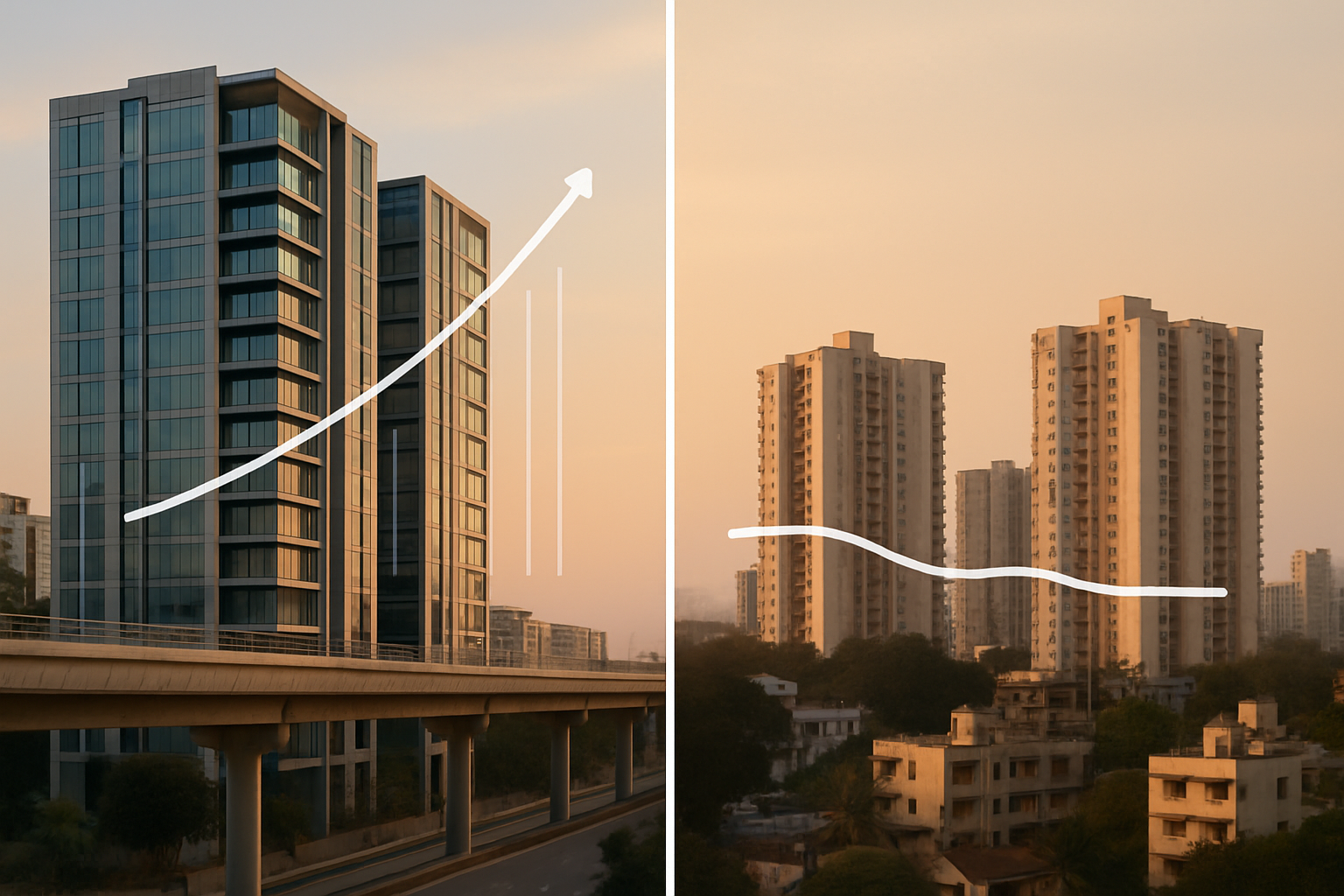
Here’s the thing nobody’s saying out loud: real estate price trends aren’t national anymore. They’re hyperlocal. A 3 km radius can have three completely different trajectories based on school quality, last-mile connectivity, and whether the sewage system actually works.

The North-South Price Divide That Data Misses
Pull up any national real estate market analysis and you’ll see averages. Averages lie.
Southern markets—Bengaluru, Hyderabad, Chennai—absorbed price increases better because job growth stayed consistent. Tech hiring slowed, sure, but it didn’t collapse. Property rates in Hyderabad’s Gachibowli are up 9% year-on-year. Not because of speculation—because end-users kept buying. First-time homebuyers with actual home loans, not investors flipping pre-launch inventory.
Northern markets are messier. NCR’s been on a rollercoaster. Noida and Greater Noida saw sharp corrections in 2024, stabilized in 2025, and are now inching up—but selectively. Projects near the Noida International Airport corridor? Hot. Older micro-markets like Crossing Republik? Still struggling to find buyers at 2022 prices.
Mumbai defies all logic. It always has. Asking rates in central suburbs increased 7% despite inventory sitting longer. Developers aren’t budging because land costs won’t let them. But transaction volume’s down 14% compared to last year. Fewer deals at higher prices—that’s not growth, that’s market friction.
Western markets—Pune, Ahmedabad—are where the mid-market buyer actually has negotiating power. For the first time in three years, buyers aren’t desperate. They’re comparing. They’re asking for possession timelines in writing. They’re walking away when numbers don’t add up. That shift changes everything about how housing price trends India will shape up in the next 18 months.
Where Price Growth Is Real and Where It’s Wishful Thinking
We track over 47,000 live listings on Freeperty. Patterns emerge when you watch the same properties get relisted with different prices, different brokers, and different stories.
Plots in metro-adjacent areas—real growth. A 150 sq. yard plot in Devanahalli (Bengaluru) that sold for ₹54 lakh in early 2024 is now quoted at ₹67 lakh. Buyers see plots as inflation hedges and future project sites. That demand’s legitimate.
Luxury segment above ₹3 crore—real growth in select pockets. South Bengaluru, South Delhi, South Mumbai—if it’s south of something expensive, it’s probably doing fine. HNI buyers aren’t rate-sensitive. They’re location-obsessed and vendor-picky.
Mid-range apartments (₹60 lakh to ₹1.2 crore)—this is where the fight is. Developers want 8-12% annual growth. Buyers are offering 3-4%. Deals are happening at 5-6% above last year’s rates, but only when the project’s near possession and the builder has a reputation worth protecting.
Rental-yield properties—the math stopped working. A ₹90 lakh apartment in Whitefield renting for ₹28,000 a month gives you a 3.7% gross yield. After society maintenance, property tax, and vacancy periods, you’re at 2.1% net. Fixed deposits are paying more. Investors noticed. Demand for such properties stalled.
Commercial real estate—office spaces in major business districts saw price stability, but co-working’s changed the game. Why buy when you can flex? Retail’s bifurcated—high street’s expensive and mostly occupied, while mall anchor spaces are seeing deals because e-commerce keeps eating their lunch.
The NRI Factor That Skews Perception
NRI buyers create price mirages. They tour India for two weeks, see five properties, pick one, pay asking price, fly back. Brokers love them. They reset price expectations for an entire micro-market based on deals that don’t reflect ground reality.
Example: a techie from Seattle bought a villa plot in North Bengaluru for ₹2.3 crore—18% above the last local transaction. Next three sellers listed at similar premiums. None sold for eight months. Eventually, two closed at prices just 6% above the original benchmark. But for those eight months, the “market rate” looked inflated.
NRIs also concentrate in specific projects—typically ones with brand-name builders, dollar-payment plans, and English-speaking sales teams. That creates pockets of artificial demand. Sobha, Prestige, Brigade, Godrej—their projects see NRI buying that doesn’t spill over into the broader market. If you’re analyzing property market trends by looking only at these enclaves, you’ll think prices are soaring. Move 4 km away—different universe.
NRI investment behavior also lags local sentiment by 6-9 months. They’re reading last quarter’s news while making this quarter’s decisions. That delay can either cushion a falling market or overheat a rising one—but it definitely distorts price discovery.
What Freeperty Data Shows That Paid Portals Hide
Paid listing platforms have an incentive problem. Developers and large brokers pay for prominence. Their inventory—often overpriced, under-delivered, or stalled—gets pushed to the top. Individual owners and small brokers with realistic pricing get buried. The “trending prices” you see reflect who paid for visibility, not what the market’s actually doing.
At Freeperty, every listing is free. No premium placements. No promoted projects. What rises to the top is what people actually search for and click on. That creates a different picture of real estate price trends.
We’re seeing individual owners list properties 8-14% below builder rates in the same area. And they’re selling faster. Buyer behavior shows price sensitivity even in a so-called “hot market.” The ₹80 lakh apartment moves in 42 days. The ₹91 lakh identical unit sits for 110 days. That ₹11 lakh difference isn’t about value—it’s about crossing a psychological threshold.
Another pattern: properties with clear titles, possession-ready status, and realistic pricing get 3x more genuine inquiries than under-construction projects with glossy brochures. Buyers got burned in the 2016-2019 cycle. They remember. Trust beats aspiration in 2026.
Channel partners and independent property consultants listing on our platform are also pricing more aggressively than large brokerages tied to builder inventory. They’re deal-focused, not fee-focused. That’s dropping effective transaction prices even as listed prices hold steady. The gap between asking rate and closing rate? For apartments in Pune, it’s averaging ₹4.7 lakh. In Noida, ₹6.2 lakh. Nobody talks about that gap—but it’s where real price trends live.
How to Read Price Trends Without Getting Fooled
Stop trusting average price per square foot across an entire city. It’s meaningless. Bengaluru’s “average” includes Whitefield penthouses and Nelamangala budget flats. The average tells you nothing about where you should actually buy.
Start with micro-market analysis. Pick a 2-3 km radius. Track 10-15 comparable properties over 90 days. Watch how many reduce prices, how many get relisted, how long they sit. That’s your real trend.
Look at transaction registrations, not listing prices. Sub-registrar office data is public. It shows what people actually paid—not what sellers wish they’d paid. In Karnataka, you can check Kaveri Online Services. In Maharashtra, there’s MahaRERA. Use them.
Verify infrastructure timelines independently. A metro station “coming soon” might mean 2027 or 2032. That four-year gap is the difference between a smart buy and dead capital. Check project status on official transport authority sites, not builder brochures.
Talk to people who already live there. Not just owners—tenants, shopkeepers, security staff. They’ll tell you about water shortages, traffic nightmares, and whether the area’s genuinely improving or just being marketed that way. Ground intelligence beats data dashboards every time.
Why This Market Feels Different Than 2016 or 2020
Buyer behavior changed. Fundamentally. The 2016 demonetization and 2020 pandemic taught people that real estate isn’t a foolproof wealth escalator. It’s illiquid, high-maintenance, and only valuable if someone else wants it when you need to sell.
Developers are also more cautious. RERA put enough penalties in place that fly-by-night operators mostly vanished. What’s left are slower-moving, better-capitalized players who can’t afford reputation damage. That’s good for buyers—but it also means less speculative supply, which can ironically keep prices higher than fundamentals suggest.
Interest rates aren’t helping. Home loans are still at 8.5-9.5%. At ₹75 lakh loan over 20 years, you’re paying ₱67,000+ EMI. That’s limiting how much young buyers can borrow, which caps transaction prices in the first-time buyer segment. Unless rates drop below 8%, that ceiling stays.
And then there’s simple math. For property rates India to grow 10% annually when GDP’s growing at 6-7% and salaries in most sectors at 4-6%—something has to give. Either incomes catch up, prices correct, or the market bifurcates permanently into investor-class and everyone-else.
Frequently Asked Questions
Are property prices going up or down in 2026?
Both, depending where you look. Metro core markets are seeing 4-7% growth in select segments. Peripheral areas and tier-2 cities are seeing 0-3% growth or even slight corrections. There’s no single national trend—real estate is hyperlocal.
Which cities have the best real estate price trends right now?
Hyderabad and Bengaluru for residential. Consistent job growth supports end-user demand. Pune for buyer negotiation power—inventory levels give you leverage. Avoid tier-2 cities unless you’re buying for self-use, not investment.
How do I know if a property is overpriced?
Compare it to three similar properties sold (not listed) in the last 90 days within 1 km radius. Check sub-registrar transaction data. If asking price is 12%+ above recent transactions without clear upgrades, it’s overpriced. Walk away or negotiate hard.
Should I wait for prices to drop before buying?
If you need a home and found one that fits your budget, buy it. Waiting for a crash that might not come costs you rent and mental peace. If you’re investing for returns, property’s not the best option right now—equity and debt instruments are more liquid with better risk-adjusted returns.
How accurate are online property price estimates?
Not very. Most are algorithm-based averages that don’t account for actual condition, title issues, or micro-market nuances. Use them as a starting point, not gospel. Physical inspection and local broker insight matter more than any automated valuation.
Track Real Price Trends Where Properties Actually Sell
The smartest way to understand real estate price trends is to watch what’s actually moving—not what’s being promoted. Freeperty shows you live inventory from owners, brokers, channel partners, and developers, all in one place, with no premium placements distorting what you see.
Every listing is free. Every search is open. No subscription walls between you and market reality. Whether you’re buying your first apartment in Pune or tracking plot appreciation in Devanahalli, you’re seeing the same data as everyone else—which means you’re seeing what prices actually are, not what someone paid to make them look like.
If you’re serious about understanding where housing markets are headed, stop reading predictions and start watching transactions. List your property, search live inventory, or just track an area you’re interested in. The patterns will show themselves faster than any analyst report.
Visit Freeperty or reach out if you want help reading the market without the noise.