
Meta Title
Real Estate Investment Mistakes: 10 Pitfalls Every Buyer Must Avoid
Meta Description
Avoid costly real estate investment mistakes. Learn the 10 most common property buying errors that drain returns and how smart investors sidestep them in India’s market.
Full Article
Real Estate Investment Mistakes: The 10 Costly Errors That Drain Your Returns
Here’s what most first-time property investors get wrong — they think the biggest risk is picking the wrong location. It’s not. The biggest risk is buying property the way everyone else does without questioning whether those assumptions still hold.
We’ve watched hundreds of buyers make the same real estate investment mistakes, year after year. Some lose 20% of their investment value before they even complete the purchase. Others lock their money into assets that won’t appreciate for a decade. The worst part? Most of these property buying mistakes are completely avoidable once you know what to look for.
This isn’t another generic list. Every mistake here comes from real investor experiences in India’s property market — the ones that cost actual money, not just theoretical losses.
Myth 1: Location Matters Most — Everything Else Is Secondary
Everyone repeats this. Few people question it.
Yes, location matters. But here’s the real estate error most people commit — they overpay for established locations while ignoring fundamentals everywhere else. A premium flat in a saturated neighbourhood with zero infrastructure development planned for the next eight years isn’t a smart buy. It’s an expensive parking spot for your money.
We’ve seen investors in Pune buy properties in “prime” areas at ₹14,200 per square foot, only to watch prices stagnate for three years. Meanwhile, buyers who picked emerging corridors with metro extensions and IT park developments saw 31% appreciation in the same period.
The smarter framework: location intelligence beats location premium. Look at infrastructure pipelines, not current prestige. Check what’s being built within 5 kilometres — metro stations, business parks, hospitals, schools. That context tells you more than the current pin code status.
One investor we know bought a plot in what brokers called a “C-grade area” outside Bangalore. Two years later, an electronics manufacturing hub was announced 3 kilometres away. His investment doubled. He didn’t get lucky — he checked the industrial zoning maps and development authority meeting minutes before buying.
Location is the starting point, not the finish line. Don’t let it blind you to everything else.
Buying Based on Launch Price Instead of Market Comparable Value
Developers are brilliant at pricing psychology. They launch projects at rates that look attractive compared to nearby completed buildings. You see ₹6,800 per square foot when finished apartments sell for ₹9,200, and your brain screams “deal.”
That’s rarely a deal. That’s a time cost you’re not calculating.
Here’s the property investment pitfall: under-construction properties take 3 to 5 years to complete in India — sometimes longer. During that time, your money is locked. You’re paying EMIs on a loan for an asset you can’t use or rent out. Meanwhile, the “expensive” ready-to-move property starts generating rental income from month one.
Do the math properly. A ready property at ₹9,200 per square foot that gives you ₹22,000 monthly rent beats an under-construction unit at ₹6,800 that gives you nothing for four years. The rental income alone recovers ₹10,56,000 over those four years — more than enough to justify the higher entry price.
We saw this play out in Gurgaon. An NRI bought an under-construction 3BHK for ₹1.1 crore in 2019, expecting possession in 2021. It’s still not ready. His colleague bought a resale flat for ₹1.35 crore and has collected ₹10.8 lakh in rent since then. Guess who made the better investment?
Always calculate total cost of ownership, not just purchase price. Time has a price tag most buyers ignore.
Skipping Title Verification Because the Builder Looks Legitimate
Big builder. Fancy brochures. Celebrities in the ads. Must be safe, right? Wrong assumption. Dangerously wrong.
Some of the messiest title disputes we’ve tracked involved projects by builders with 20-year track records. One case in Noida involved a reputed developer whose land had three separate ownership claims buried in revenue records. Buyers discovered this only after paying 80% of the property value.
Title verification isn’t optional paranoia. It’s basic due diligence. And “the builder will handle it” isn’t due diligence — it’s wishful thinking.
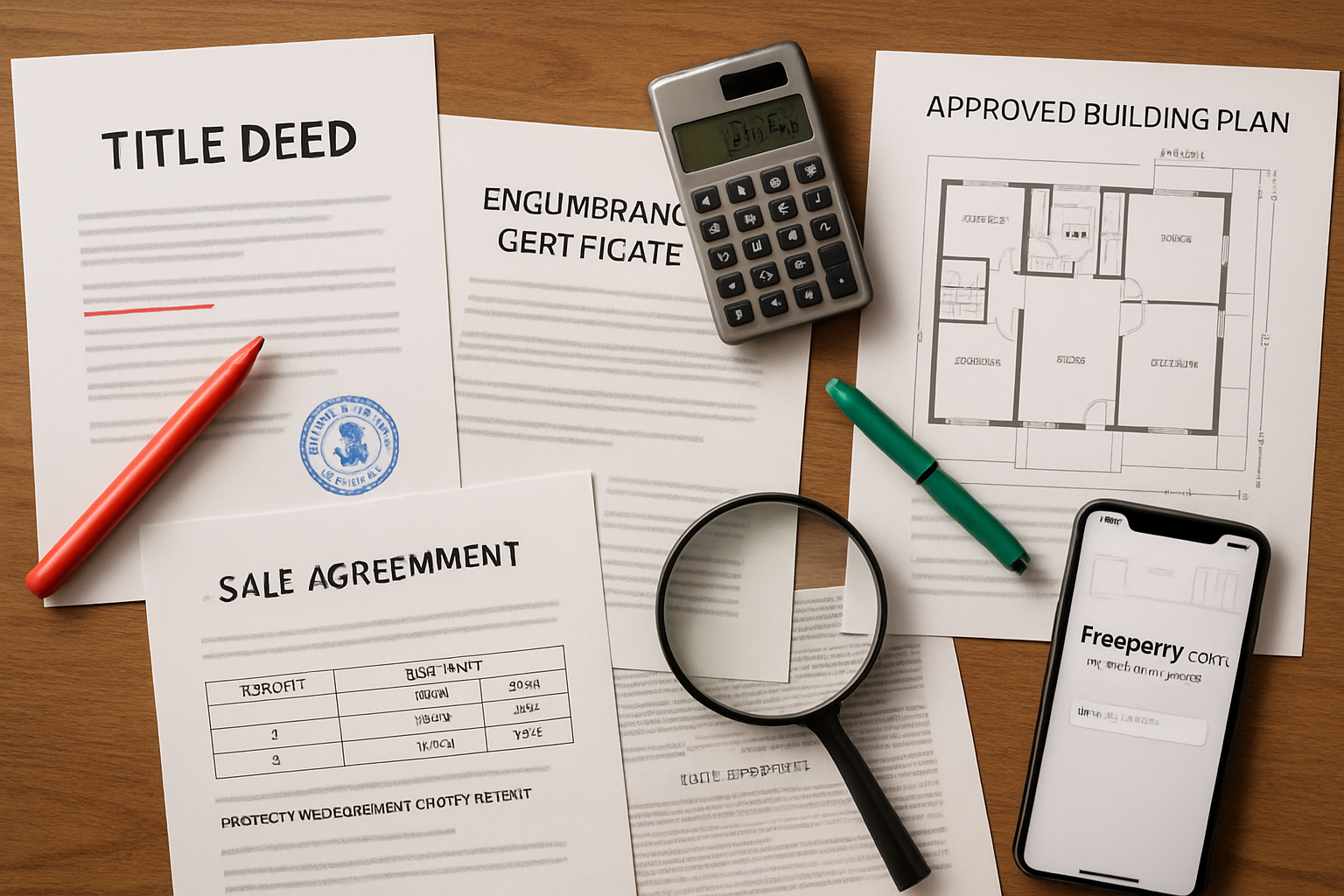
Here’s what proper verification looks like: hire an independent property lawyer. Get a title search going back 30 years minimum. Check encumbrance certificates. Verify that the person selling actually owns what they’re selling and has the legal right to transfer it. Cross-check property boundaries with revenue maps and municipal records.
Yes, this costs ₹15,000 to ₹35,000 depending on complexity. That’s nothing compared to the ₹60 lakh you’re about to spend. One document missing, one signature forged, one inheritance claim unresolved — any of these can lock your property in court for years.
Freeperty doesn’t just list properties — we emphasize verified listings with proper documentation as a baseline for trust. Verification protects both buyers and genuine sellers.
Don’t outsource your risk to someone whose incentive is to close the deal, not protect your money.

Ignoring the Actual Rental Yield in Your Investment Calculation
Most buyers claim they’re “investing” in property. Then they pick locations and property types that generate 2.1% rental yield in a market where fixed deposits give 7%.
That’s not investing. That’s expensive asset hoarding.
Here’s the real estate investment mistake: confusing ownership with returns. A 4BHK luxury apartment in a gated township might feel like an achievement, but if it rents for ₹35,000 monthly against a ₹2.2 crore purchase price, your yield is 1.9%. After maintenance and property tax, you’re barely breaking even while your capital sits locked.
Compare that to a 2BHK in a mid-market locality that costs ₹68 lakh and rents for ₹18,000 monthly. That’s 3.2% yield — still not spectacular, but significantly better. More importantly, it attracts consistent tenant demand. Your property doesn’t sit vacant for four months every time a tenant leaves.
We tracked rental performance across six Bangalore micro-markets last year. Properties priced between ₹50 lakh and ₹90 lakh had 89% occupancy rates. Properties above ₹1.8 crore averaged 67% occupancy. Luxury tenants are pickier, slower to commit, and fewer in number.
If you’re buying for rental income, optimize for yield and occupancy, not aspirational square footage. If you’re buying purely for appreciation, be honest about that and don’t pretend rental income will cover your EMI. It won’t.
Falling for Amenities That Add Cost But Not Value
Clubhouse with a gym. Rooftop infinity pool. Mini golf course. Sounds premium. Feels premium. Costs premium. Rarely worth it.
Here’s what happens in reality: you pay ₹400 to ₹800 extra per square foot for a project with 17 amenities. Then you pay ₹4,500 to ₹8,500 monthly in maintenance to keep those amenities running. You use three of them. The rest become expensive Instagram backdrops you stop noticing after six months.
The bigger problem? These amenities don’t proportionally increase resale value or rental appeal. A 2BHK with a functional layout, proper ventilation, and good connectivity will rent faster than a poorly designed 2BHK with a Jacuzzi in the clubhouse. Tenants care about commute time and livable space. Buyers care about price per square foot and appreciation potential.
We’ve seen this pattern across Mumbai and Pune — properties in amenity-heavy townships take 23% longer to rent out than comparable units in simpler complexes, because the maintenance cost makes them unaffordable for the majority of tenants.
One investor in Hyderabad bought into a project advertising 22 amenities. Five years later, he’s trying to sell. Buyers keep walking away when they hear the ₹9,200 monthly maintenance fee. His property is stuck in no-man’s land — too expensive for mid-market buyers, not premium enough for luxury buyers who want standalone villas.
Pick three amenities you’ll actually use. Ignore the rest. Your wallet will thank you.
Underestimating the True Cost of Buying and Holding Property
Purchase price is just the starting line. Registration charges, stamp duty, GST on under-construction properties, lawyer fees, loan processing charges — these add 8% to 12% to your outlay before you own a single brick.
Then come the ongoing costs. Property tax. Society maintenance. Repairs. Vacancy periods where you’re covering EMI with no rental income. Brokerage when you finally find a tenant. These aren’t occasional expenses — they’re constant drains.
Here’s the property investment pitfall most Excel sheets miss: the year you decide to sell. Capital gains tax takes 20% of your profit if you’ve held for more than two years (with indexation benefits, but still). Brokerage takes another 1% to 2%. Suddenly, the “30% appreciation” you calculated becomes 18% net return over seven years. That’s 2.57% annual return. A balanced mutual fund would’ve done better with zero maintenance headaches.
We’re not saying property is a bad investment. We’re saying you need to price in reality, not best-case scenarios. One buyer in Chennai bought a flat for ₹76 lakh, spent ₹6.8 lakh on registration and interiors, held it for four years paying ₹4,200 monthly maintenance, and sold for ₹94 lakh. After capital gains tax and brokerage, his net gain was ₹6.1 lakh. That’s 8% total return over four years — roughly 2% annually.
Property works as an investment when you buy at the right price, rent it out consistently, and hold long enough for appreciation to outpace costs. But it’s not the automatic wealth machine most people assume.
Calculate the total cost of ownership before you fall in love with a property. Numbers don’t lie. Hope does.
Buying Property You Can’t Afford to Hold for Five Years
Real estate is illiquid. Everyone knows this. Almost no one plans for it.
Here’s the common buyer mistake: stretching to buy the most expensive property you can technically afford based on current income, then discovering two years later that you need liquidity for a medical emergency, a business opportunity, or a job loss. Now you’re forced to sell in a slow market. You either take a loss or get stuck holding an asset you can’t maintain.
Property is not an emergency fund. It’s not even a medium-term investment. It’s a 5 to 10-year commitment minimum. If you can’t afford to hold it that long without selling, you can’t afford to buy it.
One Freeperty user shared his experience — bought a commercial shop in Ahmedabad planning to rent it out. Business slowed down six months later, and he needed cash to cover operational costs. Tried to sell. No buyers for eight months. Finally sold at 11% below purchase price just to exit. His expensive lesson: never lock all your capital in property if your income isn’t rock solid.
Better framework: only invest money you won’t need for the next seven years. Keep 12 to 18 months of expenses liquid. Have income sources outside of property. Then, when markets slow down or personal emergencies hit, you’re not forced to panic-sell at a loss.
Liquidity isn’t exciting. But it’s the difference between making investment decisions and being cornered into bad ones.
Relying on Verbal Promises Instead of Written Agreements
“We’ll include the car park in the sale.” “Possession by March 2024, guaranteed.” “The club membership is free for all buyers.” “Fittings and fixtures included in the price.”
If it’s not in the sale agreement, it doesn’t exist. Verbal promises evaporate faster than your down payment.
This sounds obvious until you’re sitting across from a friendly broker or a charming developer representative who’s built rapport over three meetings. Your brain wants to trust them. The deal feels done. Asking for every detail in writing feels adversarial.
Get adversarial. Get everything in writing.
We’ve tracked dozens of disputes in Mumbai and Delhi NCR where buyers paid for properties based on verbal assurances — only to discover during possession that the “included” furnishings meant doorknobs and switchboards, not modular kitchens and wardrobes. Or that “guaranteed possession” had a clause allowing 18-month delays without penalty.
One buyer in Kolkata was promised a specific apartment number with a park view. Sale agreement only mentioned the project name and unit type. At possession, he got a different floor facing a wall. Developer shrugged. “Park-facing units went to earlier buyers.” Nothing in writing meant nothing enforceable.
Every promise — size specifications, possession dates, included amenities, floor plans, payment schedules, penalty clauses — must be in the sale agreement. If the seller hesitates to put something in writing, that’s your signal they don’t intend to honor it.
Friendliness is pleasant. Documentation is protection. Choose protection.
Assuming All Property Listings Are Accurate and Honest
“1,850 square feet carpet area.” Sounds specific. Turns out it’s 1,850 super built-up area — meaning 1,340 square feet of actual usable space once you subtract common areas, wall thickness, and balconies.
Misleading measurements are one of the most common property buying mistakes, but they’re far from the only listing inaccuracy you’ll encounter.
Photos taken with wide-angle lenses make rooms look 40% larger. “Upcoming metro station” is actually 3.8 kilometres away and scheduled for completion in 2028 — maybe. “Ready for possession” means OC is pending but the builder is confident it’ll arrive soon. “Vastu-compliant” means someone added that tag to attract searches, not that any expert verified it.
Here’s what we’ve learned building Freeperty as a transparent marketplace: verification matters more than volume. Anyone can post a listing with exaggerated claims. Platforms that allow buyers to search properties freely, contact owners directly, and ask pointed questions reduce the room for deception.
Always verify listing claims independently. Visit the property yourself. Measure room dimensions. Check the actual distance to landmarks using Google Maps, not the listing description. Read the sale deed for official measurements. Ask for OC and CC copies. Talk to current residents if it’s an existing building.
One investor in Jaipur almost bought a “200-square-yard plot” based on online photos and a broker’s tour. He ordered an independent survey before finalizing. Actual plot size: 167 square yards. The rest was encroached common passage that couldn’t be used. That ₹8,500 survey saved him ₹4.6 lakh in overpricing.
Trust, but verify. Especially verify.
Buying Property Without a Clear Exit Strategy
Most buyers think about entry — down payment, loan eligibility, possession timeline. Almost nobody thinks about exit. When will you sell? To whom? At what price? Under what market conditions?
Without an exit strategy, you’re not investing. You’re accumulating.
Here’s the property investment pitfall: buying property that appeals to you personally but has a narrow resale market. A 4BHK farmhouse-style villa 40 kilometres from the city might be your retirement dream. But if you need to sell before retirement, your buyer pool is tiny. It’ll sit on the market for months, possibly years, while you bleed maintenance costs and opportunity costs.
Compare that to a 2BHK in a well-connected suburb with schools, hospitals, and offices nearby. Resale market is huge — young couples, small families, working professionals. Even in a slow market, you’ll find buyers within 60 to 90 days.
We saw this in Bangalore. One investor bought a luxury penthouse for ₹3.2 crore. Tried to sell four years later when he moved abroad. Took 11 months to find a buyer, finally sold at ₹3.4 crore. After holding costs and brokerage, he barely broke even. His friend bought two 2BHK flats for ₹1.6 crore each in a middle-income neighborhood. Sold both within 45 days at ₹1.93 crore each when he needed to exit. Smaller ticket size, bigger buyer pool, faster liquidity.
Before you buy any property, ask yourself: if I needed to sell this in 18 months, how hard would it be? If the answer is “very hard,” rethink the purchase. Illiquidity is expensive. Sometimes fatally expensive.
How to Avoid These Real Estate Investment Mistakes Starting Today
None of these real estate errors are complicated. They’re just not obvious until you’ve made them once.
The pattern we’ve seen across hundreds of property transactions is simple — buyers who treat property purchases like business decisions do well. Buyers who treat them like emotional milestones overpay, underestimate costs, and regret their choices within three years.
Smart property investment starts with removing emotion from the process. Don’t buy because your cousin bought. Don’t buy because prices “might” go up. Don’t buy because you feel you’re “supposed to” own property by a certain age.
Buy because the numbers make sense. Because the rental yield justifies the investment. Because you’ve verified every claim. Because you can hold for seven years without stress. Because you’ve calculated exit options. Because the property fits a strategy, not just a feeling.
At Freeperty, we’ve built a marketplace that puts transparency first — no subscription fees blocking access, no incentive to mislead buyers with inflated listings, just open access to properties across India with direct contact to owners and brokers. The goal is simple: make property discovery searchable, honest, and accessible so buyers can make informed decisions instead of pressured ones.
Start with research. Visit properties. Ask difficult questions. Verify everything. Calculate total costs. Plan your exit. Ignore the hype.
That’s how you avoid mistakes. That’s how you build wealth through property.
Frequently Asked Questions
What is the biggest mistake first-time real estate investors make in India?
Overestimating rental yield and underestimating holding costs. Most first-time investors calculate appreciation optimistically but forget to include registration charges, ongoing maintenance, property tax, vacancy periods, and transaction costs when selling. This leads to disappointing actual returns compared to expectations.
How can I verify if a property listing is accurate?
Visit the property in person. Measure room dimensions yourself. Check the actual distance to claimed landmarks using mapping tools. Ask for legal documents — sale deed, OC, CC, title papers. Talk to existing residents if it’s an occupied building. Cross-check listed square footage with official sale documents, not marketing brochures. Independent verification costs time but prevents expensive mistakes.
Should I buy under-construction or ready-to-move property?
Ready-to-move property almost always beats under-construction for investment purposes. You can rent it immediately, generating income while waiting for appreciation. Under-construction properties lock your capital for 3 to 5 years with zero returns during that period. Unless the developer has a flawless delivery record and the price difference is substantial, ready properties offer better liquidity and lower risk.
What are the hidden costs of buying property in India?
Beyond purchase price, expect 8% to 12% in registration and stamp duty, 1% to 2% for legal verification, loan processing fees of 0.5% to 1%, plus GST on under-construction properties. Ongoing costs include property tax, society maintenance (₹2 to ₹10 per square foot monthly), repair funds, and vacancy-period EMI coverage. Budget an extra 15% above purchase price for total first-year costs.
How do I calculate if a property is actually a good investment?
Calculate rental yield (annual rent divided by property cost), subtract all holding costs (maintenance, tax, loan interest), and compare net return to alternative investments like mutual funds or fixed deposits over the same time horizon. Factor in capital gains tax when you sell. If net annual return is below 6% to 7% after all costs, the investment case is weak unless you have specific appreciation data for that micro-market. Always calculate worst-case scenarios, not best-case projections.
Ready to Avoid Real Estate Investment Mistakes? Start With Better Property Discovery
Avoiding these property buying mistakes starts with access to honest, transparent property information. No hidden fees. No subscription walls. Just open search and direct contact with property owners, brokers, and developers across India.
Whether you’re buying your first home, investing in plots, or searching for rental property, Freeperty gives you the visibility and choice you need to make informed decisions — not rushed ones.
List your property for free. Search thousands of properties for free. Build your real estate strategy on transparency, not marketing pressure.
Visit Freeperty today and discover property the smarter way.