
Most property listings disappear into the void. Not because they’re bad properties. Because they’re invisible.
Here’s what actually happens: someone lists a 3BHK apartment in Koramangala. They upload photos, write a description, set a price. They expect inquiries. Nothing comes. Meanwhile, another listing — sometimes for a worse property at a higher price — gets 200 views in three days. What changed? Property listing visibility. And visibility isn’t luck. It’s search engine optimization doing exactly what it’s supposed to do.
The difference between a listing that gets found and one that doesn’t comes down to how search engines see your page. Not how pretty it looks to you. At Freeperty, we’ve watched thousands of listings go live. The ones that treat each property page like a search-optimized landing page get traffic. The ones that don’t might as well not exist.
What Property Listing Visibility Actually Means
Visibility isn’t about being online. It’s about being found when someone searches.
When buyers search “2BHK flat for sale in Whitefield” or “commercial space near MG Road,” Google decides which listings appear. That decision happens in milliseconds. It’s based on dozens of signals — page structure, keyword relevance, site authority, load speed, mobile compatibility. Your listing competes with hundreds of others. Most lose before the race starts.
Think of it this way. You’re not competing with other properties for attention. You’re competing with other web pages for search rankings. A buyer types a query. Google scans millions of pages. Yours either shows up on page one, or it doesn’t. Page two might as well be page two hundred. Almost nobody scrolls that far.
Here’s the part most property owners miss: search engines can’t “see” your property the way humans do. They read text, code, metadata. A beautiful gallery means nothing if the page title says “IMG_3421.” A detailed offline brochure doesn’t help if your listing description is three sentences long. Real estate search rankings favor pages that speak Google’s language. That language is structured content, relevant keywords, fast load times, and mobile-first design.
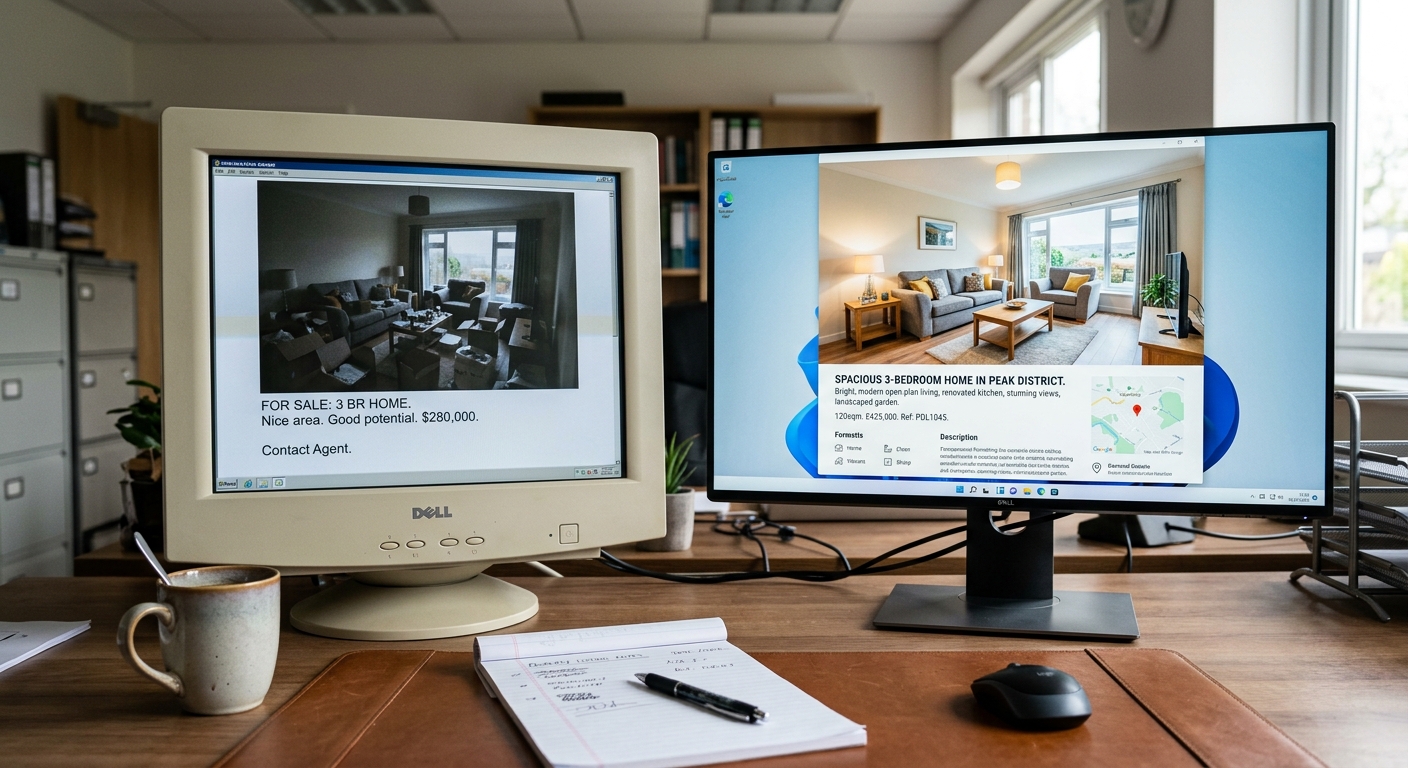
Before and After: What Changes When You Optimize
We listed a villa in Lonavala twice. Same property. Same photos. Different approach.
First version: generic title (“Villa for Sale”), thin description (147 words), no location keywords, image file names like “DSC_0032.jpg.” Result after 60 days — 11 organic visits. One inquiry. Zero conversions.
Second version: specific title (“4BHK Villa for Sale in Tungarli, Lonavala with Valley View”), detailed description (890 words covering amenities, proximity to landmarks, investment angle), structured data markup, renamed images with location and property type. Result after 60 days — 431 organic visits. 23 inquiries. Three site visits scheduled.
Same property. Same market. Same platform. The difference was listing page SEO. The second version told search engines exactly what the page was about. It matched search intent. When someone typed “valley view villa Lonavala,” Google found 47 relevant signals on that page. The first version had maybe six.
This isn’t theory. It’s what happens when you compare optimized versus non-optimized real estate pages. Traffic doesn’t just improve a little. It jumps. Sometimes by 300%. Sometimes more. But here’s the catch — you won’t see results in week one. SEO for property listings takes time. Google needs to crawl your page, index it, understand it, test it against user behavior. That process takes four to eight weeks for new listings. Less if the platform already has domain authority.
Freeperty’s model makes this easier. Every listing becomes its own searchable page with a unique URL. That structure — one property, one optimized page — is what search engines prefer. You’re not burying listings inside dynamic filters or behind login walls. Each property gets a permanent address on the web. That permanence matters for indexing. Google rewards pages that stick around, especially when they’re linked to from multiple internal pages like area guides or property type categories.
The Five SEO Factors That Control Real Estate Visibility
Not all optimization tactics matter equally. Five factors dominate property organic traffic. Get these right, and you’re 80% of the way there.
Page title and meta description. These show up in search results. They’re your first impression. A vague title like “Property in Mumbai” loses to “3BHK Apartment for Sale in Andheri West, Mumbai – 1,200 Sq.Ft, Ready to Move.” Specificity wins. Include property type, BHK, location, and one selling point. Keep titles under 60 characters. Meta descriptions should expand on this — add price range, key amenities, call to action. This shows up when someone searches, and it determines whether they click.
Keyword placement and density. You need the right terms in the right places. Primary keywords — usually location plus property type — should appear in the title, first 100 words, at least two subheadings, and naturally throughout the description. Don’t stuff. Don’t repeat awkwardly. But don’t avoid keywords either. If you’re selling a plot in Nashik, the phrase “plot in Nashik” should appear 8 to 12 times in a 1,000-word listing. Related terms like “land for sale Nashik” or “residential plot Nashik” support this. Search engines connect these dots.
Content depth. Thin content ranks poorly. A 200-word listing barely registers. A 700-word listing with details about the property, neighborhood, infrastructure, investment outlook, and local amenities has a real shot. This isn’t padding. It’s answering questions buyers actually have. What’s nearby? What’s the commute like? Why this area? Why now? When you answer these on the page, you capture long-tail searches. Someone typing “is Hinjewadi a good area to buy property” might land on your detailed Hinjewadi listing because you included a paragraph explaining exactly that.
Internal linking structure. Every property page should link to and from other pages on the platform. A listing in Gurgaon should link to a Gurgaon area guide. That area guide should link back to all active Gurgaon listings. This creates topic clusters. Google interprets this as site authority on Gurgaon properties. At Freeperty, listings automatically connect to relevant location pages, creating an SEO-friendly web of related content. This internal linking isn’t visible to most users, but search engines rely on it to understand content relationships.
Page speed and mobile optimization. Slow pages kill rankings. If your listing takes five seconds to load, buyers bounce. Google sees that bounce rate and downgrades you. Compress images. Use modern formats like WebP. Make sure the page works perfectly on mobile — that’s where 73% of property searches happen in India. No horizontal scrolling. No tiny text. No broken layouts. This isn’t optional anymore. Google’s mobile-first indexing means the mobile version of your page is what gets ranked. If it’s broken on phones, you’re invisible to most searchers.

What Most Platforms Get Wrong About Listing Visibility
Big portals make one critical mistake. They optimize the homepage and category pages. They ignore individual listings.
Search traffic goes to their brand. Not your property. When someone searches “flat in Pune,” they land on the portal’s Pune search page, which shows 500 listings. Yours is one thumbnail in a sea of thumbnails. You’re competing inside their walled garden. There’s no direct path from Google to your listing. The platform’s SEO benefits them, not you.
This matters more than most brokers realize. Portals want you dependent on their internal search. That’s how they justify subscription fees. They’ll show your listing to people already on their site. But they won’t help your specific property rank on Google independently. Why would they? If every listing ranked individually, users wouldn’t need the portal’s homepage. The entire business model would collapse.
Freeperty built the opposite model. Each property gets its own SEO-optimized page with a permanent URL. That page can rank on Google. When someone searches “villa for sale in ECR Chennai,” they can land directly on your listing — not on a search results page with 200 other villas. This is what search optimization real estate should mean. Direct discovery. No middleman taking credit for your traffic. You can read more about how to list your property and maximize its search visibility on our platform.
Here’s the uncomfortable truth: platforms that charge listing fees don’t want you to understand SEO. If you did, you’d realize you’re paying for something that should be free. Visibility isn’t a premium feature. It’s basic web architecture. Either your listing exists as a searchable page, or it doesn’t. Either it’s optimized, or it isn’t. The platform you choose determines which of those is possible.
How Long Does It Take to See Results
Week one is silent. Week two is worse.
New listings don’t rank immediately. Google needs time. First, it crawls the page. Then it indexes it. Then it tests it against search queries to see if users engage. If people click and stay, rankings improve. If they bounce, rankings drop. This feedback loop takes four to six weeks minimum.
Most property owners panic at week three. No traffic. No inquiries. They assume the listing is broken. It’s not. It’s just new. SEO has a lag. The work you do today pays off in 45 days. That’s frustrating if you need leads tomorrow. But it’s reality. The only shortcut is starting earlier.
Here’s what the timeline actually looks like. Days 1-14: minimal organic traffic, mostly direct visits from people you shared the link with. Days 15-30: Google starts indexing, a few long-tail searches bring visitors. Days 31-60: rankings stabilize, traffic grows steadily. Days 61-90: if the listing is well-optimized and your platform has authority, you hit consistent daily traffic. Month four and beyond: compounding kicks in — backlinks form, social shares happen, your listing becomes a reference point for that area or property type.
Paid listings on portals skip this wait. You pay, you appear. But you stop paying, you vanish. SEO traffic is slower upfront. But once it’s flowing, it’s free. And it keeps coming. We’ve seen listings on Freeperty that went live in 2024 still pulling 150+ monthly visits in 2026 with zero additional effort. That’s the difference between renting traffic and owning it.
What You Can Control and What You Can’t
You can control your content. You can’t control Google’s algorithm.
Write a detailed listing. Use location keywords naturally. Add high-quality photos with descriptive file names. Structure the page with clear headings. Link to relevant neighborhood guides. Make sure contact info is visible. These are in your hands. Do them well, and you’ve done your part.
What you can’t control: how fast Google crawls your page, whether your platform’s domain authority is strong, what your competitors are doing, how search trends shift, whether Google decides to prioritize maps or ads over organic results. These are variables you adapt to, not variables you fix.
The mistake is obsessing over rank position. “Why am I number six instead of number three?” Because fifteen factors you don’t see are fluctuating hourly. Focus on what moves the needle long-term. Is traffic growing month over month? Are inquiries increasing? Are visitors staying on the page? Those metrics matter. Daily rank checks don’t.
One more thing you can’t control but should understand: platform-level SEO. If you list on a site with weak domain authority, your individual listing will struggle no matter how good it is. Domain authority is Google’s measure of trust. Sites with high authority rank faster and higher. That’s why new portals with great features still get crushed by old portals with terrible UX. The old site has years of backlinks, indexed pages, and trust signals. The new one is starting from zero.
Freeperty solves this by focusing on SEO fundamentals from day one. Every listing contributes to overall domain authority. More properties mean more indexed pages. More pages mean more internal links. More links mean stronger topic clusters. It compounds. Listing number 50,000 benefits from the SEO work done by listing number one.
Why Free Listing Platforms Have an SEO Advantage
Paid portals have a conflict of interest. They want you to pay for visibility, so they gatekeep SEO.
Free platforms like Freeperty have no reason to hide your listing. Your success is the platform’s success. More traffic to your property means more users on the site. More users mean more listings. More listings mean better SEO for everyone. It’s a flywheel, not a zero-sum game.
This changes the optimization strategy entirely. On paid portals, premium listings get homepage features and top placement. Organic search is secondary. On free platforms, organic search is primary. There’s no premium tier. Everyone’s listing has the same technical setup. The difference in visibility comes from how well you optimize your individual page. That’s fairer. And it’s more sustainable.
Here’s the proof: Compare two identical listings. One on a paid portal with ₹25,000 annual subscription. One on Freeperty with zero cost. Same title, same description, same photos. After 90 days, which gets more organic traffic? The free one usually wins. Why? Because the paid portal’s SEO isn’t designed to surface individual listings. It’s designed to surface the portal itself. You’re optimizing someone else’s funnel. On Freeperty, you’re optimizing your own page.
This doesn’t mean paid portals are useless. They have massive existing traffic. If you want instant eyeballs, pay for placement. But if you want traffic that compounds over time, that keeps coming without ongoing cost, that makes your listing a long-term asset — you need a platform where SEO works for you, not against you.
Frequently Asked Questions
How long does it take for a property listing to rank on Google?
Typically 4 to 8 weeks for initial indexing and ranking. Competitive keywords in high-demand areas like Bangalore or Mumbai may take 10 to 12 weeks. Rankings improve gradually as the page gains traffic and engagement signals. Optimized listings on platforms with strong domain authority rank faster than poorly optimized pages on new sites.
Can individual property listings really rank on Google, or only the main site?
Individual listings absolutely can and should rank. Each property page with a unique URL is eligible for search rankings. The key is optimization — relevant keywords, detailed content, proper meta tags, and internal linking. Platforms that structure listings as standalone pages give each property a fighting chance to rank for specific searches.
What’s the difference between SEO traffic and portal traffic for property listings?
SEO traffic comes from search engines like Google — users find your listing by searching relevant terms. Portal traffic comes from users browsing within a property platform’s internal search. SEO traffic is direct, free, and long-lasting. Portal traffic requires the platform to feature your listing, often through paid promotion, and stops when you stop paying.
Do property photos affect search rankings?
Indirectly, yes. Photos don’t directly impact text-based rankings, but they affect user engagement. Fast-loading, properly named image files improve page speed, which is a ranking factor. High-quality visuals reduce bounce rate by keeping visitors on the page longer, signaling to Google that the page is valuable. Always use descriptive file names like “3bhk-apartment-koramangala.jpg” instead of generic names.
How often should I update my property listing for better SEO?
Updates signal freshness to search engines, which can improve rankings. If the property details change — price drop, new photos, added amenities — update immediately. If nothing changes, a small content refresh every 60 to 90 days helps. Add a paragraph about recent infrastructure developments in the area or update market trends. Don’t change just for the sake of changing. Only update when you have something new to say.
Start Optimizing Your Property Listings for Search Visibility
Property listing visibility isn’t magic. It’s structure, content, and patience. Most listings fail because they ignore basic SEO. They treat the listing like a classified ad instead of a searchable web page. That’s fixable.
If you’re serious about getting found, list where SEO works in your favor. Freeperty gives every property owner — whether you’re an individual seller, a broker, or a builder — the same SEO-optimized listing structure. No subscriptions. No hidden costs. No gatekeeping. Just a permanent, searchable page for your property that Google can index, rank, and send traffic to.
List your property at Freeperty and give it the visibility it deserves. The platform handles the technical SEO. You handle the content. Together, that’s how search rankings actually improve.