
Rajesh sent us an email from Singapore at 2 AM India time. He’d found what looked like the perfect 3BHK apartment in Pune. Great location. Decent price. The builder’s website looked professional. He’d even done a virtual walkthrough. Ready to wire the booking amount. Just one question: “What should I check before I transfer the money?”
That email saved him from a mess. The project had an ongoing legal dispute. The land title had a cloud. The builder was marketing units he couldn’t legally sell yet. None of this showed up in the glossy brochure or the video call with the sales team.
NRI property investment India is not just about finding the right property — it’s about verifying everything before you commit. Distance makes you vulnerable. Time zones complicate communication. And the Indian real estate ecosystem, while improving, still has enough friction points to catch you off-guard if you don’t know what to check.
We’ve worked with hundreds of NRIs through Freeperty — from first-time buyers to seasoned investors building portfolios across multiple cities. The ones who sleep well at night? They’re the ones who did their homework upfront. Here’s the exact checklist we’ve built from watching deals go right and deals go wrong.
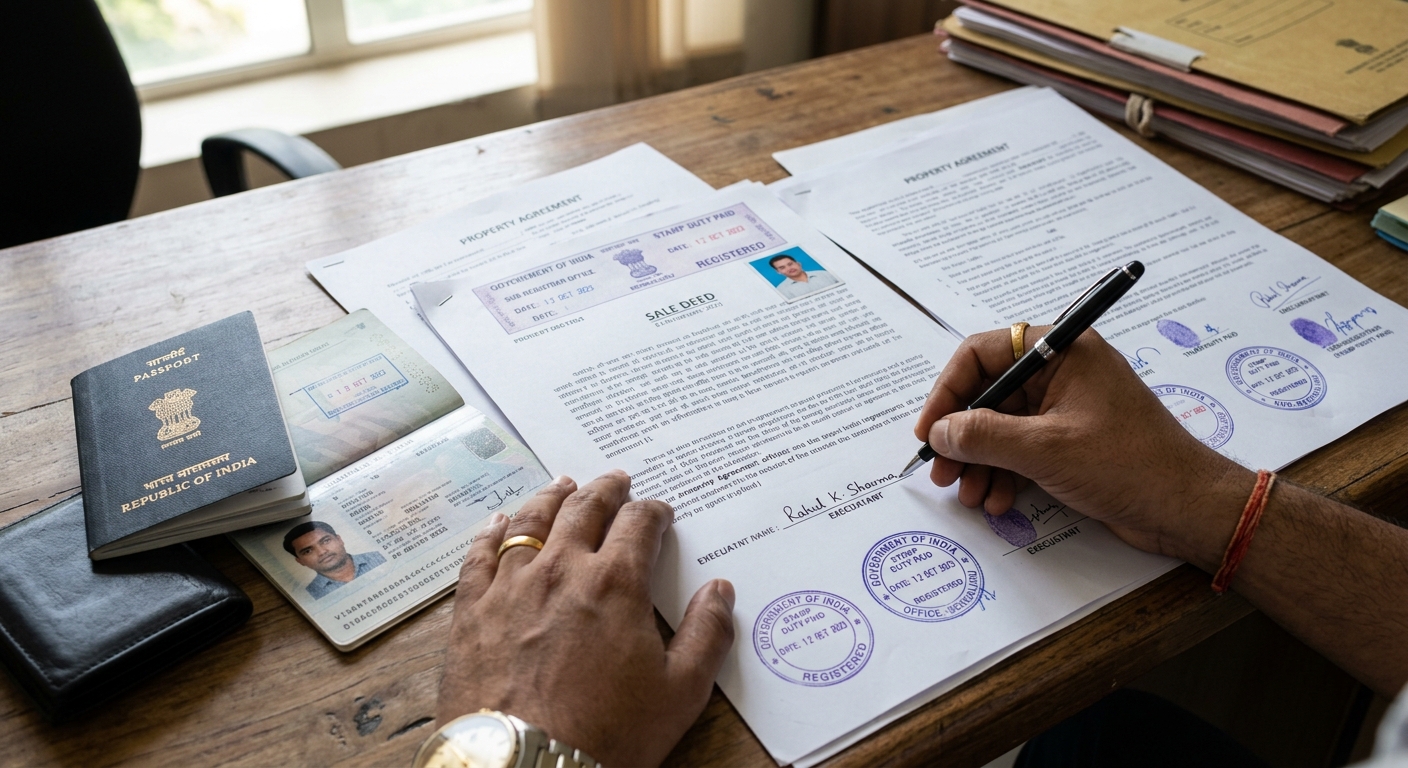
Why NRI Property Due Diligence is Different From Resident Buyer Checks
You can’t just drop by the property office. Can’t walk into the local municipal corporation and pull records. Can’t meet the builder’s previous buyers for coffee. Everything happens through intermediaries, video calls, and digital documents.
That distance amplifies every risk. A resident buyer might notice that the builder’s office is a small room with two desks. You see a professional Zoom background. A local buyer hears neighbourhood gossip about project delays. You get official timelines that sound optimistic.
We’ve noticed something else. NRI buyers often move faster because they’re working around limited India trips. That urgency is visible. And some sellers use it. The pressure to “book now before prices go up” or “only two units left at this rate” hits harder when you’re flying back to Dubai in three days.
Indian real estate NRI transactions also carry unique legal requirements — FEMA compliance, specific documentation, restrictions on certain property types. Miss one of these, and your purchase can get stuck in legal or banking limbo even after you’ve paid.
Legal Title Verification: The Non-Negotiable Foundation
Start here. Always. Title issues are the single biggest source of long-term trouble in property transactions.
You need a complete chain of ownership going back at least 30 years. Not just the immediate previous owner. The entire history. Who owned it before them? How did they acquire it? Were there any disputes, liens, or encumbrances?
Get a lawyer who specializes in property title searches. Not your cousin who’s a corporate lawyer. Not a general legal consultant. Someone who does title verification as their primary work. They’ll check sale deeds, mutation records, encumbrance certificates, and cross-verify with land records.
At Freeperty, we’ve seen cases where everything looked clean on paper until a lawyer dug three ownership transfers back and found a partition dispute from 1998 that was never fully resolved. That’s a lawsuit waiting to happen. The current seller might not even know about it.
Check the Encumbrance Certificate from the local sub-registrar office. This document shows all transactions — sales, mortgages, leases — registered against the property for a specific period. If there’s a mortgage that wasn’t cleared, it’ll show up here. If the property was sold twice (yes, this happens), you’ll know.
For under-construction projects, verify that the builder has clear title to the land. Don’t assume. We’ve worked with NRI clients who discovered mid-construction that the builder had a development agreement, not outright ownership, and that agreement had conditional clauses that weren’t being met.
Also check: is the property in a litigation-free zone? Some areas have ongoing land acquisition disputes, slum rehabilitation complications, or tenancy issues that can freeze transactions for years.
RERA Registration and Project Approvals
If you’re buying under-construction property, RERA registration isn’t optional anymore — it’s legally mandatory for projects beyond a certain size. But here’s what most overseas buyer checklists miss: RERA registration exists, but that doesn’t mean the project is compliant.
Check the RERA website for your state. Look up the project. Verify the registration number the builder gave you actually matches. Then go deeper. What’s the project’s completion timeline on RERA? Does it match what the sales team told you? Are there any complaints filed against the builder on the RERA portal?
Get copies of all approvals — commencement certificate, building plan approval, environmental clearance (if applicable), fire safety NOC, occupation certificate (for ready properties). Don’t just ask if they have them. Ask for copies. Verify them with the issuing authority if you can.
We had a case where a builder in Goa showed an approval letter that looked official. The NRI buyer’s lawyer called the planning authority. The approval had been granted, then suspended, then partially reinstated with conditions. The builder was marketing units in wings that weren’t cleared yet.
For plotted developments, check that the layout is approved. That the demarcation matches the approved plan. That the plot number you’re buying actually exists in the sanctioned layout and isn’t a creative subdivision the developer did without permission.
Also verify: Does the builder have an Occupancy Certificate (OC) or Completion Certificate (CC) for ready properties? No OC means you can’t legally occupy the property, can’t get utilities connected, and banks might refuse a home loan against it.
FEMA Compliance: What NRIs Can and Cannot Buy
This is where NRI property investment India gets legally specific. Not all property types are open to you.
You can buy residential and commercial property. You cannot buy agricultural land, plantation property, or farmhouses as an NRI. If you’re a Person of Indian Origin (PIO) or an Overseas Citizen of India (OCI), the same restrictions apply.
There’s a workaround some sellers mention: buy agricultural land, then convert it to non-agricultural use. Don’t do this. The conversion process is complicated, often gets stuck, and you can’t legally hold the land in your name until conversion is complete.
Freeperty sees this confusion often. A beautiful farmhouse property listed in the outskirts. Looks perfect for a retirement home. But it’s classified as agricultural land. An NRI cannot buy it. End of story.
Also know this: you can buy property through a General Power of Attorney (GPA), but the payment must come from NRE or FCNR accounts, or from funds remitted through normal banking channels. Cash transactions will cause problems. Keep every trail documented.
If you’re buying jointly with a resident Indian, the structure matters. If it’s with a resident spouse, you’re usually fine. If it’s with a sibling or parent who’s a resident, check how that affects repatriation rights later.
Repatriation is the other part of FEMA compliance. You can repatriate sale proceeds of up to two residential properties. Beyond that, you’ll need RBI approval. Plan accordingly if you’re building a portfolio.
Financial Due Diligence and Payment Structure
Know the total cost — not just the property price. Registration charges, stamp duty, GST (for under-construction), legal fees, maintenance deposits, and preferential location charges (PLC) can add 8-12% to the sticker price. Budget for it upfront.
For under-construction projects, insist on a payment plan linked to construction milestones, not time-based installments. You pay when the builder completes the foundation. When the structure reaches a certain floor. When plastering is done. This is standard now, but some builders still push for time-linked schedules, which leave you exposed if construction stalls.
Never pay in cash. Every rupee should move through banking channels. This isn’t just about compliance — it’s about having an audit trail if something goes wrong.
Check if the builder has a separate escrow account for the project. Post-RERA, this is mandatory for larger projects. Your money is supposed to go into this account and be used only for that specific project, not diverted to the builder’s other ventures.
We’ve seen deals where NRI buyers negotiated great prices but didn’t lock in the payment structure in writing. Builder later demanded faster payments. Created pressure. Had leverage because the buyer already made initial payments and didn’t want to lose them. Get everything in writing before you pay the first installment.
Also verify: If you’re taking a home loan, does the lender have any objections to the project or the builder? Banks do their own due diligence. If they’re refusing loans for a particular project, that’s a red flag.
Builder and Developer Background Check
Look beyond the current project. How many projects has this builder delivered? Are they on time? We’ve built our own system at Freeperty for tracking builder delivery timelines across cities. The gap between promised and actual possession dates tells you everything about execution capability.
Talk to existing buyers if possible. Not the testimonials on the builder’s website. Actual buyers. Visit online forums, Facebook groups for the project or the builder. You’ll find out about hidden charges, quality issues, delays, and how the builder handles complaints.
Check the builder’s financial stability. Are they overleveraged? Do they have multiple ongoing projects that might be competing for resources? A builder juggling ten projects simultaneously is riskier than one focused on two or three.
Look for past litigation. Some builders have serial disputes with previous buyers, contractors, or landowners. This isn’t always disqualifying — real estate involves disputes — but a pattern of similar complaints is a warning sign.
At Freeperty, we maintain builder profiles that track project history and delivery records. Not to block anyone, but to give buyers context. A first-time developer isn’t necessarily bad, but you need to price that risk into your decision.
Also check: Is the builder’s customer service responsive? If they’re dodging questions before you’ve paid, imagine what happens after.

Documentation Checklist for NRI Property Due Diligence
Here’s what you need in hand before you sign anything. Not promises. Actual documents.
Sale deed or allotment letter. Agreement for sale. Title deed chain. Encumbrance certificate. Property tax receipts (make sure they’re paid up to current date). Building plan approval. Occupancy certificate or completion certificate for ready properties.
For under-construction: RERA registration certificate. Approved building plans. Commencement certificate. Construction and payment schedule. Project specifications sheet. List of amenities with delivery timelines. Escalation clauses (if any).
For resale properties: previous sale deed. No-objection certificate from the housing society. Share certificate (if applicable). Maintenance clearance certificate. Existing loan clearance letter (if the seller has a mortgage).
Get a Property Identification Document (PID) or Unique Property ID if your state has implemented it. This helps avoid confusion in areas where plot numbers and survey numbers get messy.
If you’re appointing someone through a Power of Attorney, make sure the POA is specific, time-bound, and registered. A general POA can be misused. We’ve worked with clients who gave broad powers and ended up with property registered in structures they didn’t intend.
Keep certified copies of everything. Don’t rely on the builder or broker holding the originals “for safekeeping.”
Site Inspection and Physical Verification
You can’t be there in person every week. But you need eyes on the ground at key stages.
Hire a local property consultant or inspection service. Not the broker who’s selling you the property. An independent verifier. They should visit at construction milestones, take photos and videos, and report on actual progress versus promised timelines.
For plotted developments, physically verify the plot boundaries. We’ve seen cases where the plot size on paper was 2400 sq ft but the actual demarcated area measured less. Discrepancies happen. Catch them early.
Check the neighbourhood. Is the infrastructure around the property developing as promised? Are the roads being laid? Is the metro line actually coming, or is it a rumor the builder’s marketing as fact?
Talk to neighbours if it’s a resale property. They’ll tell you about water supply issues, power cuts, drainage problems, or society disputes that won’t show up in any document.
For under-construction projects, visit competitors’ projects in the same area. Compare quality, pricing, timelines. You’ll get a sense of whether your deal is genuinely good or just marketed well.
At Freeperty, we encourage buyers to use virtual walkthroughs and video inspections, but always combine them with at least one in-person verification by someone you trust before final payment.
Tax Implications and Long-term Holding Considerations
Property investment documentation isn’t complete without understanding tax consequences. You’ll pay tax in India on rental income. You’ll pay capital gains tax on sale. Some of this can be repatriated, some can’t without additional approvals.
Long-term capital gains tax has indexation benefits if you hold the property for more than two years. That can significantly reduce your tax burden on sale. But you need to maintain proper documentation from the day of purchase — cost of acquisition, improvement costs, everything.
If you’re buying for rental income, factor in TDS. Tenants are required to deduct TDS before paying rent to NRIs. Make sure this is structured correctly, or you’ll have compliance headaches.
Also think about succession. Indian property laws around inheritance can be complex, especially if you have legal heirs in different countries. A clear will is essential.
We’ve worked with NRIs at Freeperty who bought property but didn’t set up proper management for rent collection, maintenance, tax filing. The property became a burden instead of an asset. Plan for ongoing management before you buy.
Red Flags That Should Stop You Immediately
Some warning signs are absolute deal-breakers. Walk away if you see these.
Builder refuses to provide RERA registration or says “it’s in process” for a project that should already be registered. Seller discourages you from hiring your own lawyer and suggests using theirs. Documents have mismatched details — different plot numbers, different area measurements in different papers.
Builder asks for payments outside the registered agreement or into personal accounts instead of the company escrow account. Property is being sold significantly below market rate with a vague explanation. Seller is in a desperate hurry and pressuring you to skip verification steps.
There’s an ongoing court case related to the property or the land, and the seller downplays it as “just a technicality.” Builder has a history of project abandonment or years-long delays on past projects.
Trust your instinct. If something feels off, it usually is. We’ve never seen a case at Freeperty where an NRI buyer regretted being too careful. We’ve seen plenty where they regretted rushing.
How Freeperty Supports NRI Property Buyers Through Transparent Discovery
We built Freeperty specifically to solve the information and access problem that overseas buyers face. Every property listed on our platform is searchable, detailed, and comes without hidden subscription costs or listing fees.
That openness matters because it removes one layer of friction — you’re not filtering through gatekeepers to see inventory. You’re not paying consultation fees just to browse options. You get direct access to property listings from owners, brokers, channel partners, and developers across India.
What we’ve learned working with NRI buyers is this: transparency at the discovery stage sets the tone for transparency through the transaction. When you can compare properties openly, ask questions directly, and access location intelligence without pressure, you make better decisions.
We’re not trying to replace your lawyer or your on-ground inspector. We’re the starting point. The platform where you discover options, evaluate areas, understand pricing trends, and shortlist properties worth your due diligence time.
Frequently Asked Questions
Can NRIs buy agricultural land in India?
No. NRIs, PIOs, and OCIs cannot legally purchase agricultural land, plantation property, or farmhouses in India under FEMA regulations. You can buy residential and commercial property, but not agricultural holdings. Converting agricultural land to non-agricultural use doesn’t bypass this restriction — you cannot hold the land during the conversion process.
What is the safest payment method for NRI property investment India?
Always pay through banking channels from your NRE, NRO, or FCNR accounts. Never pay cash. Ensure payments go to the builder’s official company account or an escrow account, not personal accounts. Keep complete documentation of every transfer. This protects you legally and simplifies repatriation when you eventually sell.
How long does property due diligence take for overseas buyers?
Expect 4 to 6 weeks minimum for thorough verification. Title search takes 2-3 weeks. RERA and approval verification takes another week. Financial and builder background checks run parallel. Don’t let anyone pressure you to close faster. If you’re working around a short India trip, start due diligence remotely before you arrive.
Do I need to visit India in person to complete a property purchase?
Not mandatory if you appoint someone through a registered, specific Power of Attorney. However, we strongly recommend at least one in-person visit for site inspection and document verification before final payment, even if most of the process happens remotely. Critical decisions deserve physical presence.
Ready to Start Your Property Search With Complete Visibility?
NRI property investment India works when you have access to complete information, verify everything independently, and don’t let distance rush you into shortcuts.
Freeperty gives you that starting advantage — a completely free platform where you can explore properties across India, compare options openly, and reach out to sellers directly without subscription barriers or listing fees. Every property becomes a searchable page. Every location comes with growth intelligence and area guides.
Start your search at Freeperty. Use this checklist as your verification backbone. And invest with the confidence that comes from doing your homework right.