
High Appreciation Real Estate Zones: How to Spot Growth Early
Learn how to identify high appreciation real estate zones before prices spike. Practical signals most buyers miss — infrastructure, zoning, and migration patterns that predict growth.
We’ve watched property owners buy in “emerging areas” that never emerged. And we’ve seen smart investors pick up land in overlooked pockets that doubled in three years. The difference wasn’t luck. It was knowing what to look for before the market noticed.
Most buyers chase appreciation after it’s already happened. They read about Whitefield or Hinjewadi after prices have tripled, then go hunting for “the next Whitefield” with no real framework. That’s not prediction — that’s hope with a mortgage attached.
Real appreciation happens in stages. There are signals — subtle, sometimes boring, often ignored — that tell you where growth is building. You just need to know where to look and what actually matters. Not what brokers highlight in a sales pitch. Not what sounds exciting at a family dinner. What moves prices.
Here’s what we’ve learned working with property owners, channel partners, and investors across India’s real estate ecosystem — including plenty of mistakes that taught us what doesn’t work.
Myth 1: Infrastructure Announcements Guarantee Appreciation
This is the most expensive belief in real estate. A metro line gets announced. A new airport is planned. A highway extension makes the news. Prices jump overnight. Everyone assumes the area is “set to boom.”
Here’s the problem: announcements don’t build infrastructure. Execution does. And execution in India often takes five to ten years longer than promised, if it happens at all.
We’ve seen plots near “upcoming metro stations” stay stagnant for eight years because the metro never came. By the time buyers realized the project was delayed indefinitely, their capital was locked, and better opportunities had passed.
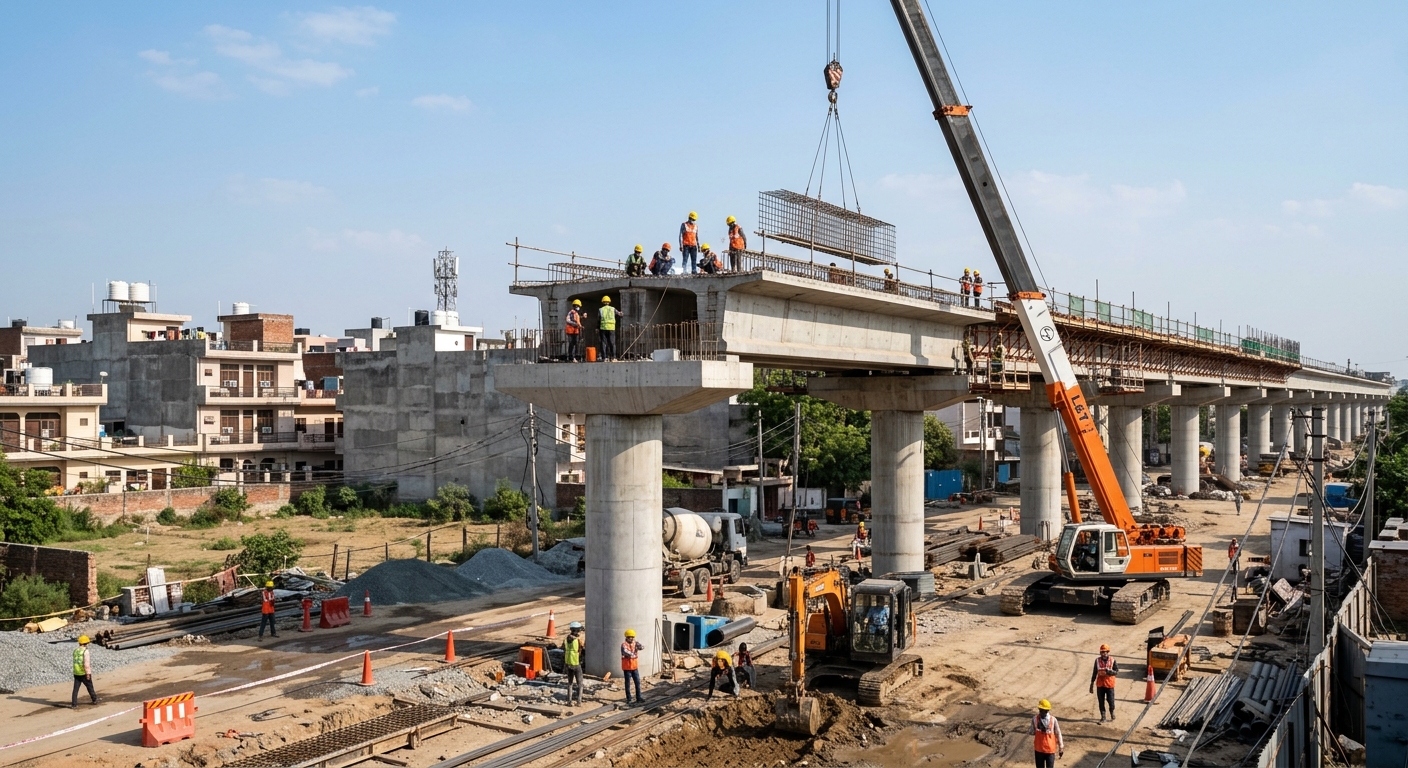
Infrastructure matters — but only when it’s already under construction or nearly operational. Announced projects create hype. Half-built projects create impatience. Completed projects create actual appreciation.
Look for areas where physical work has started. Check the project’s actual progress, not the press release. Visit the site. See if machinery is moving. Talk to local shopkeepers and residents — they know if construction has stalled or if timelines are being met.
And here’s the nuance most people miss: it’s not just about the infrastructure itself. It’s about who it connects. A metro line linking a residential suburb to an employment hub? That appreciates. A metro line connecting two residential areas with no office density? Not as much. Context beats headlines.
When Freeperty lists properties near infrastructure projects, we track completion timelines and link to official project updates — because hope isn’t an investment strategy. Buyers deserve to know what’s real and what’s speculative.
Myth 2: You Need Inside Information to Spot Growth Early
People think identifying high appreciation real estate zones requires insider access — knowing a politician, being friends with a developer, hearing rumors from a broker who “has sources.”
That’s partly true for immediate, artificial spikes driven by land deals or policy announcements. But sustainable, long-term appreciation? That’s visible to anyone who knows what data to check and where to look.
You don’t need secret sources. You need pattern recognition and public data.
Start with migration trends. Check where companies are opening offices, where IT parks are expanding, where new educational institutions are setting up. Employment drives housing demand. Housing demand drives price growth. Follow the jobs, not the billboards.
Look at building permit data — most municipal corporations publish this online, even if it’s buried in PDFs. Rising permit approvals in a locality signal developer confidence and upcoming supply. But cross-check that against current inventory. Too many permits with weak absorption? That’s oversupply waiting to happen.
Google search trends reveal intent before transactions do. If searches for “flats in [Area X]” or “plots near [Project Y]” are climbing steadily over six months, demand is building quietly. By the time brokers start hyping it, early-stage appreciation has already begun.
We made this mistake once with a residential pocket near Pune. Search interest was flat. Developers were slow to enter. We thought it was undervalued. Turns out, it was just uninteresting — no job hubs, poor connectivity, limited schools. The area didn’t grow. It aged.
Contrast that with another neighborhood we tracked where tech companies started leasing office space, followed by co-working hubs and a few CBSE schools setting up branches. Within 18 months, residential listings doubled and asking prices climbed 15 to 20 percent. No insider information. Just observation.
The most overlooked signal? Retail activity. When national retail chains — Decathlon, IKEA, Reliance Trends, even a decent Starbucks — start opening outlets in a previously ignored area, they’ve done market research you don’t have to repeat. They’ve seen purchasing power, footfall projections, and demographic shifts. Retail follows wealth. Wealth creates appreciation.
Myth 3: Emerging Neighborhoods Are Always Cheap
This one kills portfolios. Buyers assume that “emerging” means “affordable.” It doesn’t. It means “in transition.” And in transition areas can already be expensive if the market has priced in future potential.
High appreciation real estate zones aren’t always cheap when you find them. Sometimes they’re moderately priced but undervalued relative to what’s coming. Sometimes they’re already at a premium, but poised to widen the gap even further.
The real question isn’t “Is this cheap?” It’s “Is this mispriced relative to fundamentals?”
A plot priced at ₹8,000 per square foot sounds expensive. But if it’s 2 kilometers from a nearly complete metro station, surrounded by gated communities, and zoned for mixed-use development? That’s not expensive. That’s late-stage affordable.
A plot priced at ₹2,500 per square foot sounds like a steal. But if it’s in a flood-prone area with no road access, weak title clarity, and zero nearby employment? That’s not cheap. That’s a trap.
We’ve watched buyers on Freeperty chase the lowest per-square-foot price, ignoring every other variable. One investor picked up farmland an hour outside Bengaluru because it was “only ₹800 per square foot.” Three years later, it’s still farmland. No rezoning. No road widening. No appreciation. Just holding costs and frustration.
Meanwhile, another buyer paid ₹12,000 per square foot for a villa plot in an established layout near Sarjapur with clear titles, water connection, and established resale activity. That plot is now quoted at ₹18,000. It wasn’t cheap when he bought it. But it was correctly priced for momentum.
Price alone tells you nothing. Look at price trajectory — is it climbing steadily or stagnant? Look at transaction velocity — are properties moving, or sitting listed for months? Look at the buyer profile — are end-users moving in, or is it purely speculative?
Emerging neighborhoods to invest in aren’t defined by low entry price. They’re defined by improving fundamentals that the broader market hasn’t fully priced in yet. That window is narrow. And it closes faster than people expect.
Myth 4: Appreciation Happens Evenly Across a Locality
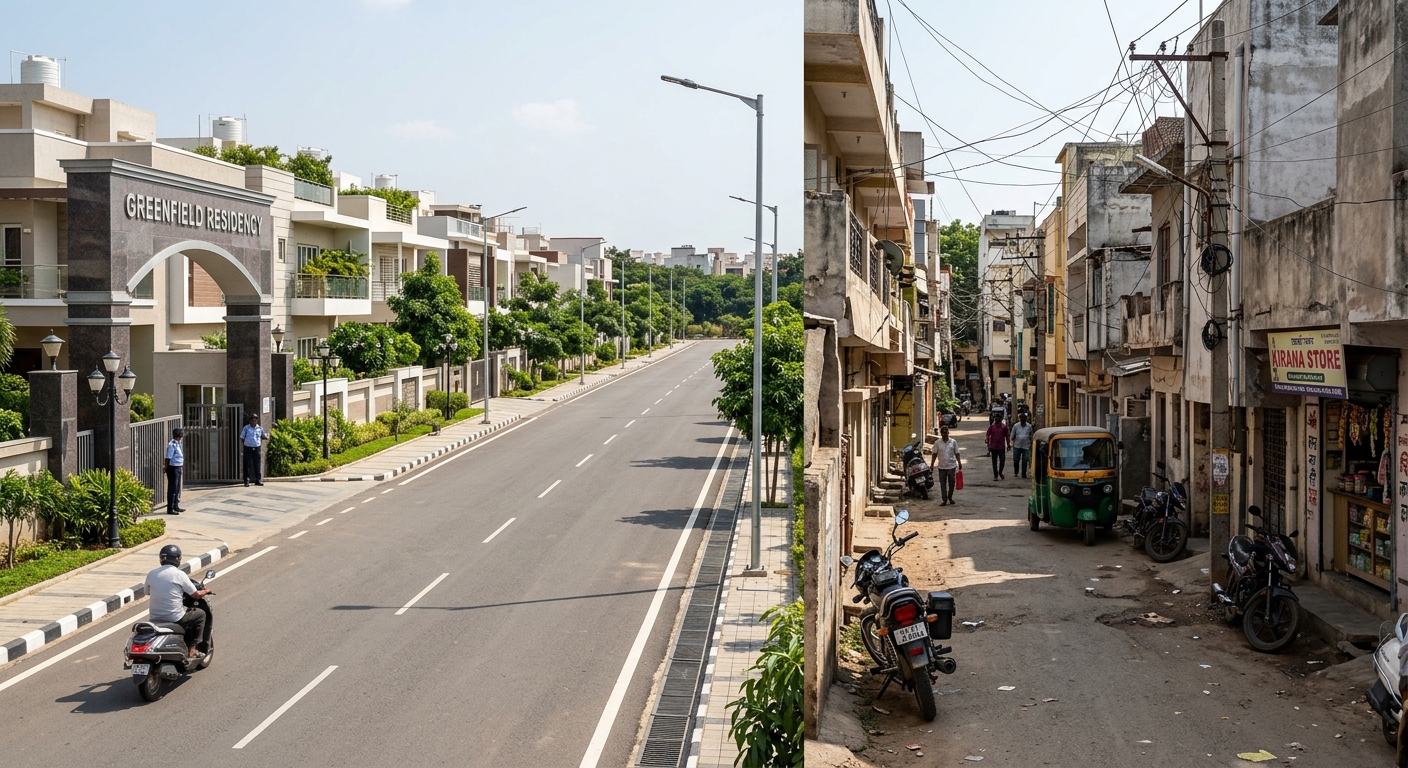
Here’s what nobody tells first-time investors: even within a single pincode, appreciation is uneven. One street booms. The next street barely moves. The difference might be 500 meters and a drainage line.
Micro-location beats macro-location every time. And most buyers don’t zoom in enough.
Two plots in the same suburb. One faces a 60-foot road with street lights and tree cover. The other is on a 20-foot internal lane with open drains and poor lighting. Same locality. Same “emerging neighborhood” tag in marketing brochures. Completely different appreciation curves.
The plot on the wide road will attract end-users, families, and buyers who plan to build immediately. It will appreciate steadily because livability is already there. The plot on the narrow lane will only attract speculators hoping for infrastructure upgrades that may never come. It might appreciate if the entire area transforms — but that’s a bigger if.
We’ve seen this play out repeatedly in suburbs around Mumbai, Pune, and Bengaluru. Developers launch projects on the best plots first — the ones with road access, clear titles, and no encroachments. Those sell fast and appreciate predictably. The leftover plots, often marketed as “last few units” or “extended phase,” sit longer and appreciate slower, if at all.
Street-level details matter more than people admit. Is there a functioning sewage system, or do residents rely on septic tanks? Is there piped water supply, or do tankers come twice a week? Are there transformers and reliable power, or frequent outages? Is there mobile network coverage, or dead zones?
These aren’t minor conveniences. They’re appreciation multipliers. End-users pay premiums for livability. Speculators don’t. If you want appreciation, you need demand from both. If you only attract speculators, you’re in a game of musical chairs — and most people lose.
When Freeperty creates area guides and location intelligence content, we don’t just highlight the suburb. We break down pocket-level differences — which layouts have better roads, which phases have clearer titles, which streets are seeing actual construction versus land-banking. That granularity is what separates real discovery from marketing noise.
What Actually Predicts Appreciation: The Signals That Don’t Lie
Forget the hype. Forget the pitch decks. Forget what your broker’s cousin’s friend thinks will “definitely double in two years.” Here’s what we’ve seen actually move property values over time, across multiple markets and cycles.
Zoning changes matter more than people realize. If an area gets rezoned from agricultural to residential, or residential to mixed-use, that’s not just paperwork. That’s a legal shift in what can be built, who can buy, and how land gets used. Check your local development authority’s master plan revisions. These are public documents. They’re also roadmaps.
Anchor institutions create gravity. A Tier-1 hospital. A reputed university campus. A large corporate office park. These don’t just serve the locality — they define it. People move closer to where they work, study, or need regular access. And once that migration starts, supporting infrastructure follows. Restaurants, gyms, clinics, retail. The ecosystem builds itself.
One mid-sized town in Karnataka saw a new medical college open on its outskirts. Within three years, residential plots nearby appreciated 40 percent, not because of hype, but because 600 students, 200 faculty, and dozens of support staff needed housing. Builders followed. Brokers followed. Prices followed. Predictable, if you were watching.
Consistent infrastructure upgrades — the boring kind — signal serious intent. Road widening. Streetlight installation. Underground cabling. Stormwater drains. These aren’t sexy. But they’re funded, planned, and executed by municipal bodies that have committed budgets. When a local body is investing in an area’s basics, they’re expecting growth. And they’re rarely wrong.
High repeat transaction activity is the most underrated signal. If properties in a locality are changing hands every 12 to 18 months, that’s liquidity. Liquidity means confidence. It means buyers believe they can exit when needed. And that belief drives prices up because risk feels lower.
Compare that to areas where listings sit for two years with no takers. Low liquidity doesn’t mean low prices — it often means sticky sellers and nervous buyers. Appreciation in illiquid markets is theoretical. You can’t realize it unless someone’s willing to buy.
We track listing-to-sale conversion timelines on Freeperty across different localities. The neighborhoods where properties move within 60 to 90 days consistently show stronger price growth than those where listings age past six months. Velocity matters.
The Timing Question: When Should You Actually Buy?
Everyone wants to “buy early.” But too early, and you’re holding dead capital. Too late, and you’ve missed the curve. The sweet spot is narrower than most frameworks admit.
Here’s a practical filter we’ve built from watching transactions, mistakes, and outcomes across hundreds of properties and partners in our ecosystem.
Don’t buy when the area is still speculative. That means no schools, no hospitals, no offices, no retail, and infrastructure that’s “planned.” You’re not early — you’re gambling.
Don’t buy when the area is fully developed and saturated. At that point, appreciation is incremental and slow. You’re paying for livability, not growth.
Buy when early signs of transformation are visible but not yet priced in by mainstream buyers. That’s the window.
What does that look like? A few gated communities under construction. One or two schools operational. A retail hub planned with foundation work started. Offices or co-working spaces opening nearby. Improved road access — not announced, but drivable. Listings increasing month-on-month, but still manageable inventory.
This is the stage where end-users start considering the area, but most investors are still ignoring it. Prices are moving, but not spiking. You can still negotiate. That’s your entry.
And here’s the mistake we made early on: confusing activity with growth. An area with heavy construction doesn’t always mean appreciation. Sometimes it just means oversupply. If builders are racing to launch projects but absorption is weak — meaning units aren’t selling — you’re looking at a glut, not a boom.
Check occupancy, not just construction. Walk through a few completed projects in the area. Are lights on at night? Are parking spots full? Are common areas maintained, or does it feel like a ghost layout? Occupancy signals real demand. Construction signals developer hope.
Real estate appreciation prediction isn’t astrology. It’s observation, cross-checked against fundamentals and timed to liquidity. The people who get it right aren’t psychic. They’re just watching closer than everyone else.
How Freeperty Helps You Spot High-Potential Areas Before the Market Does
We’re not in the business of selling you properties. We’re in the business of making properties — and the areas they’re in — discoverable. That’s a different incentive structure. And it creates different content.
Every property listed on Freeperty becomes its own SEO-driven landing page. But more importantly, every area we cover gets broken down with location intelligence — infrastructure timelines, proximity to schools and hospitals, recent price trends, transaction activity, and zoning context. Not fluff. Not hype. Just the data points that help you decide whether a neighborhood is actually growing or just being marketed as such.
We work with property owners, brokers, channel partners, and developers across India’s real estate ecosystem. That gives us visibility into where inventory is moving, where it’s stagnant, where builders are confident enough to launch new phases, and where they’re quietly pulling back. Those patterns tell a story. And that story is predictive.
Our ROI calculators and investment education content aren’t just tools — they’re frameworks. Use them to model out scenarios in neighborhoods you’re researching. Test assumptions. See how different appreciation rates change your five-year return. See how holding costs eat into speculative gains. See what happens if liquidity drops and you need to exit early.
We’ve also built property walkthroughs and area guides that go deeper than generic “top 10” listicles. We highlight micro-location differences, street-level access, title clarity trends, and buyer profiles. Because identifying high appreciation real estate zones isn’t just about picking a suburb. It’s about picking the right plot, on the right street, at the right stage of development.
And we do this without charging listing fees, subscription paywalls, or lead-unlock costs. If you’re a property owner or broker trying to reach buyers organically, Freeperty gives you the visibility larger platforms charge thousands for. If you’re a buyer trying to research neighborhoods without getting spammed by irrelevant leads, we give you the search and discovery tools to do that on your own terms.
Transparency drives trust. Trust drives transactions. And transactions reveal where real appreciation is happening — not where marketing wants you to think it is.
Frequently Asked Questions
How can I identify high appreciation real estate zones without hiring a consultant?
Start by tracking infrastructure projects that are actually under construction, not just announced. Look for areas seeing rising employment through new office parks, co-working hubs, or educational institutions. Check building permit approvals on your local municipal website and cross-reference with current inventory to avoid oversupply traps. Use Google Trends to spot increasing search interest for properties in specific localities before brokers start hyping them. Finally, visit the area multiple times at different hours — talk to shopkeepers, check occupancy in nearby projects, and see if basic amenities like water supply and drainage are functional.
What is the biggest mistake buyers make when trying to predict property appreciation?
Chasing infrastructure announcements instead of completed projects. An announced metro line or highway extension creates hype and short-term price jumps, but actual appreciation only happens when the infrastructure is operational and connecting the right places. Buyers lock capital into “upcoming areas” that stay upcoming for a decade. Always prioritize projects with visible, ongoing construction and realistic timelines over speculative announcements.
How long does it typically take for an emerging neighborhood to show significant appreciation?
In India’s real estate market, genuine appreciation in emerging neighborhoods typically takes three to five years from the point where foundational infrastructure — roads, water, power — is in place and early residential projects begin occupancy. If you’re buying purely on speculation before any infrastructure exists, you’re looking at seven to ten years or more, with no guarantees. The faster timeline happens when you enter during the transition phase — early signs visible, but mainstream buyers not yet active.
Are property investment hotspots always located near metro or IT hubs?
Not always. While proximity to metro lines and IT hubs drives demand in metros like Bengaluru, Pune, and Gurgaon, other factors create appreciation too — anchor institutions like hospitals and universities, zoning changes that allow mixed-use development, improved highway connectivity reducing commute times, and even lifestyle factors like proximity to lakes, hills, or green cover that attract premium buyers. The key is understanding what type of buyer the area will attract and whether that demand is sustainable.
Ready to Discover Properties in High-Growth Areas Before Prices Spike?
Stop chasing neighborhoods after everyone’s already bought in. Start researching smarter, with free access to listings, location intelligence, and market insights that actually help you decide.
Freeperty gives you the search tools, area guides, and property discovery platform to spot emerging neighborhoods to invest in on your own terms — no subscription fees, no hidden costs, no broker pressure. Whether you’re a first-time buyer, an NRI investor, or a channel partner building your portfolio, you’ll find transparent, SEO-driven property pages and investment education content that help you move faster than the market.
List your property for free. Search without limits. Discover areas with real potential — not just marketing noise.
Visit Freeperty today and start exploring properties in tomorrow’s hotspots while they’re still today’s opportunities.