
First Time Home Buyer Mistakes That Cost Lakhs in India
Avoid the costly errors that drain savings, delay handovers, and turn first-time homebuyers into regret stories — practical lessons from India’s property marketplace.
You found the perfect flat. Location? Great. Price? Fits your budget. Builder? Seems legit. Six months later, you’re stuck with delayed possession, hidden charges you never budgeted for, and a loan that’s eating more of your salary than you planned. Welcome to the expensive education most first-time homebuyers get in India.
We’ve watched this pattern play out across thousands of listings on Freeperty’s platform. Smart, educated buyers — engineers, doctors, mid-level managers — making the same mistakes because nobody told them what to actually look for. And it costs them. Not just money. Time, mental peace, and sometimes the entire investment.
Here’s what actually goes wrong, why it happens, and how to avoid each trap before you sign anything.
Not Understanding Your Real Budget Beyond EMI
Most first-time buyers calculate affordability like this: bank approved ₹50 lakhs, EMI is ₹40,000, I can afford it. That math is wrong, and it’s expensive.
Your real budget isn’t what the bank approves. It’s what you can pay after accounting for registration charges (7-8% of property value in most states), GST on under-construction properties (1-5% depending on category), stamp duty, maintenance deposits, interior work, and the furniture you’ll need before moving in. Add it up. A ₹50 lakh flat costs you closer to ₹58-60 lakhs before you actually live in it.
Here’s what we see repeatedly: buyers stretch to the maximum loan amount because “EMI toh afford ho jayega.” Then possession happens. Registration alone takes ₹4 lakhs. They either scramble for a personal loan at 14% interest or delay registration, which creates legal risks. One buyer we worked with on the platform postponed registration by eight months because he didn’t budget for it — paid penalty interest to the builder and nearly lost eligibility for his home loan tax benefit that financial year.
Calculate backward. Start with total cost including all charges, then figure out the property price you can actually afford. Use Freeperty’s ROI calculators not just for investment analysis but for realistic budgeting — they factor in these hidden costs most buyers miss.

Skipping Physical Site Visits for Under-Construction Projects
Photos look great. The builder’s website has a virtual tour. Your broker sent you a video walkthrough. You’re busy, the site is far, and honestly, it’s just a foundation right now anyway. So you book based on the brochure.
Huge mistake. Costs you in three ways.
First, you miss construction quality signals that only a site visit reveals. Is the steel TMT branded or random? Are they actually waterproofing the foundation or just claiming it? What’s the labor quality — experienced teams or constantly rotating contract workers? These details determine whether you’re buying a solid home or a maintenance nightmare that’ll drain ₹2-3 lakhs in repairs within five years.
Second, you don’t see the neighborhood reality. That “upcoming metro station” might be just a proposal that’s been stuck for three years. The “serene green surroundings” could be next to a garbage collection point that’s not marked on any map. The “gated community” might share a wall with a noisy commercial area. Buyers who visit the site at different times — morning, evening, weekend — catch these details. The ones who don’t, discover them after possession when it’s too late.
Third, and this one stings, you can’t verify progress claims. Builders show 40% construction complete on paper. You visit, it’s actually 20%. That two-month delay they mentioned? Try eight months. A couple bought an under-construction apartment in Pune’s Hinjewadi area through our platform listing, never visited the site, and trusted the builder’s monthly photo updates. Actual possession happened 14 months late. Their entire financial plan — selling their old house, kid’s school admission, loan pre-payment schedule — collapsed. They paid rent for an extra year while also servicing the home loan EMI.
Visit the site. Twice minimum. Once during working hours to see actual construction activity. Once on a Sunday to see the neighborhood when it’s lived-in. Take photos. Ask the site engineer direct questions. Check if the engineer is even available on site or just visits once a week.
Ignoring Legal Due Diligence Because “Builder is Reputed”
Brand name doesn’t equal clean title. Big builders have launched projects with unclear land ownership, pending litigation, or incomplete approvals. Reputation protects them through legal battles. It doesn’t protect you.
Legal due diligence isn’t optional homework. It’s the one step that determines whether you’re buying a home or buying a legal case. And most first-time buyers skip it because it feels complicated, costs ₹15,000-25,000 for a proper lawyer, and everyone around them says “this builder is trustworthy.”
Here’s what actually matters: verify the title chain for at least 30 years, check for any encumbrances or mortgages on the property, confirm all building approvals (commencement certificate, environmental clearance if applicable, RERA registration), verify that the land use matches the project type (residential project on agricultural land is a red flag), and check for any ongoing or past litigation involving the property or the builder.
One homebuyer skipped this because the project was by a well-known Bangalore builder. Turned out, a portion of the land had a legal dispute with a previous landowner. The builder settled it eventually, but possession was delayed by three years. The buyer’s home loan started, rent continued, and the flat’s market value dropped because of the project’s legal reputation by the time he finally got possession.
Use a property lawyer, not just a documentation agent. Yes, it costs more. But a good lawyer flags issues a documentation agent doesn’t even know to look for. On Freeperty, when channel partners list properties, we’ve seen cases where a lawyer’s due diligence report saved buyers from projects with hidden liabilities that looked completely legitimate on the surface.
RERA registration is mandatory, but it’s not a guarantee of zero problems. Check the RERA website for any complaints against the project. Read the registered sale agreement carefully — what are the penalty clauses if the builder delays? What are your penalty clauses if you delay a payment? They’re not symmetrical, and buyers don’t realize this until they’re stuck.
Choosing Location Based on Current Convenience, Not Future Growth
You work in Whitefield, so you buy in Whitefield. Makes sense, right? Until your company relocates, or you switch jobs, or the traffic situation worsens so badly that your 30-minute commute becomes 90 minutes in three years.
First-time buyers optimize for today. Experienced investors optimize for 5-7 years out. That’s the difference between a property that grows in value and one that stagnates.
Location choice in India’s property market isn’t about current convenience. It’s about infrastructure development, area growth trajectory, and market demand sustainability. A flat in an established area with maxed-out infrastructure might be comfortable today but appreciation will be limited. A flat in an emerging area with upcoming metro connectivity, new commercial hubs, and planned infrastructure often delivers better long-term value — even if it’s slightly inconvenient right now.
We’ve noticed a clear pattern on Freeperty: buyers who research area growth stories, track infrastructure projects in the pipeline, and talk to local brokers about demand trends end up with better investment outcomes than buyers who choose purely based on their current office location.
Example: a buyer picked a project in Pune’s Baner area in 2018 because it was close to his office. Another buyer picked Wakad, slightly farther but with the metro extension planned. Same builder, similar pricing. By 2024, the Wakad property appreciated 35% more because the metro construction news drove investor and end-user demand. The Baner property grew too, but slower — the area was already saturated.
Check these before finalizing location: what infrastructure is coming in the next 3-5 years (metro, highways, flyovers), what’s the employment hub growth in that zone, are new schools and hospitals being planned, what’s the area’s rental yield if you need to rent it out temporarily, and what’s the historical price trend — steady growth or speculative spikes and crashes?
Use area guides, talk to multiple brokers including smaller local ones who know the ground reality, and cross-check claims. “Metro station planned” could mean construction starts in one year or it could mean it’s in a 15-year master plan with no budget allocation yet. The difference matters.
Falling for Unrealistic Possession Timelines
Builder says possession in 24 months. You plan everything around that date. Month 20, you get an email: six-month delay due to “unforeseen circumstances.” Month 26, another delay. You finally get possession in month 34. Your entire financial plan is in shambles.
This isn’t bad luck. This is the norm in under-construction projects. Yet first-time buyers plan as if the timeline is guaranteed.
Add at least 30-40% buffer to whatever possession timeline the builder commits. If they say two years, plan for three. If they say three years, plan for four. This isn’t pessimism — it’s pattern recognition from how projects actually get delivered in India.
Why do delays happen? Labour shortages, approval delays from municipal authorities, funding issues if the builder’s cash flow is tight, changes in government regulations mid-project, litigation even if it doesn’t directly involve your tower, and sometimes just poor project management.
The expensive part isn’t just the delay itself. It’s the cascading financial impact. You planned to sell your old house at month 22 and move in at month 24. Now you’re paying rent for an extra 10 months while also servicing a home loan EMI on a flat you can’t occupy. That’s ₹4-5 lakhs in unplanned expenses for most buyers.
Check the builder’s track record on delivery timelines, not just their brand reputation. A “reputed builder” who consistently delays by 12-18 months is worse than a smaller builder who delivers on time. RERA project details show the committed possession date. Check if the builder has any ongoing projects — visit them, ask actual buyers there about their delay experience.
If possible, prefer ready-to-move-in properties for your first purchase. Yes, you pay slightly more upfront because the builder isn’t offering under-construction discounts. But you eliminate timeline risk entirely, you see exactly what you’re buying, and your home loan starts only when you’re ready to move in. That financial certainty is worth the 5-8% price premium for most first-time buyers.
Signing Agreement Without Reading Every Clause
You’re sitting in the builder’s office. The sales manager puts a 40-page agreement in front of you. He’s explaining key points, highlighting where you sign. You flip through, it’s dense legal language, and honestly, you’re just excited to finally lock in the deal. You sign.
Months later, you discover a clause that says if you delay any payment by even 15 days, the builder can cancel the booking and keep 10% of the amount paid. Or a clause that limits the builder’s penalty for possession delay to ₹5 per square foot per month while your penalty for payment delay is ₹15 per square foot per month. Or a clause that lets the builder make “minor alterations” to the floor plan without defining what minor means.
Every one of these clauses has cost buyers real money. We’ve seen cases where buyers lost ₹3-4 lakhs in forfeited booking amounts because they missed a payment deadline by a week due to a banking holiday — and the agreement’s strict termination clause let the builder keep the money legally.
Read the entire agreement. Not skim. Read. If you don’t understand legal language, pay a lawyer ₹3,000-5,000 to review it and explain it in plain language before you sign. Specifically check: what are the possession delay penalties, and are they sufficient to cover your actual costs if delay happens; what are the payment delay penalties, and are they proportionate; what’s the cancellation and refund policy from both sides; what changes can the builder make to the unit or project without your consent; who pays for what during registration and handover; how are disputes resolved, and in which jurisdiction; and what are the maintenance and corpus fund obligations.
Negotiate if something is unreasonable. Builders won’t change the entire agreement for one buyer, but they’ll sometimes adjust specific clauses if you push back on genuinely one-sided terms. Most buyers don’t even try because they assume it’s non-negotiable.
A buyer on Freeperty’s platform once caught a clause that made him liable for property tax from the date of agreement signing, even though possession was two years away and legally property tax is the owner’s responsibility only after possession. He pushed back, the builder changed it to “property tax from possession date,” and he saved ₹35,000.
Maxing Out Loan Eligibility Without Emergency Buffer
Bank approved ₹60 lakhs. You take ₹60 lakhs. Your EMI is now ₹52,000. Doable on your current salary, as long as nothing changes. Then something changes.
Medical emergency. Salary cut during a business downturn. Unexpected home repairs. Parent needs financial help. Suddenly, that ₹52,000 EMI you could “easily afford” is suffocating you. You start delaying payments. Credit score drops. Stress piles up.
Taking maximum loan eligibility is the most common mistake first-time buyers make because it lets them buy a bigger or better-located property than they’d otherwise afford. But it leaves zero financial cushion for the reality that life doesn’t follow your budget spreadsheet.
Limit your home loan to a level where the EMI is no more than 35-40% of your take-home income. Yes, banks will approve up to 50-60%. Don’t take it. The extra 10-15% buffer is your protection against the unexpected — and in a 20-year loan period, the unexpected will definitely happen.
Put down a bigger down payment if you can. Every extra lakh you pay upfront reduces your EMI and your total interest burden. A ₹50 lakh loan at 8.5% for 20 years means you pay ₹43 lakhs in interest alone. A ₹40 lakh loan at the same rate? You pay ₹34 lakhs in interest. That ₹10 lakh bigger down payment just saved you ₹9 lakhs over the loan tenure.
First-time buyers often drain every savings account to maximize the property purchase. Wrong move. Keep at least 6 months of expenses including EMI in liquid emergency savings after your down payment. This buffer protects you from forced loan defaults if income is disrupted.
Focusing Only on Carpet Area, Ignoring Actual Usable Space
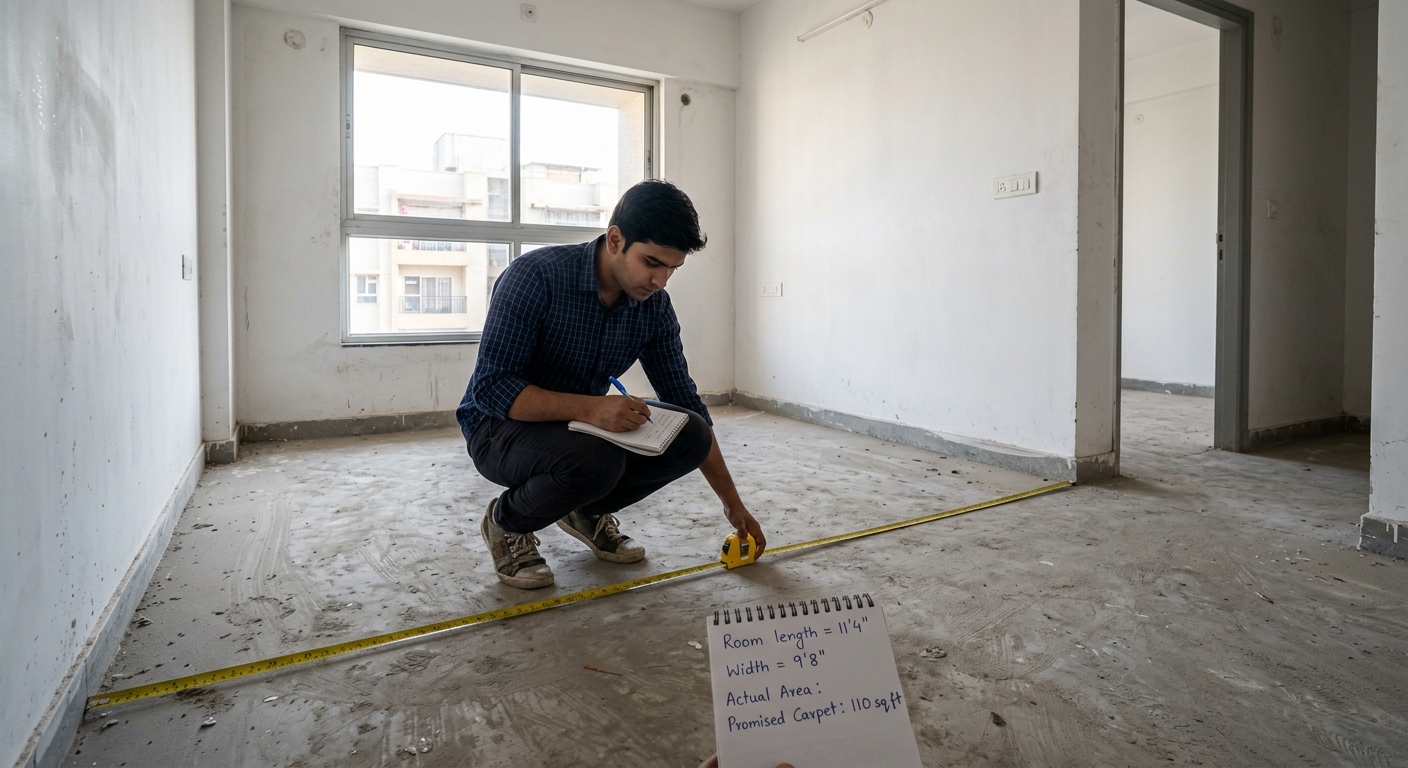
The brochure says 1000 sq ft. You calculate cost per square foot, it seems reasonable. You book. You move in. The place feels smaller than you expected. You measure. The actual usable space is closer to 750 sq ft. The rest is walls, ducts, and common areas you’re paying for but can’t use.
Carpet area is what the builder advertises. Usable area is what you actually live in. For most apartments, usable area is 70-75% of carpet area. Builders don’t highlight this. First-time buyers don’t realize it until they start planning furniture placement and nothing fits the way they imagined.
Ask for the carpet area measurement specifically, and check how it’s calculated. Under RERA rules, builders must sell based on carpet area, not super built-up area. But what’s included in “carpet area” can still vary. Does it include balcony? Does it include wall thickness?
Visit similar completed units by the same builder if possible. Measure the actual room dimensions. A “3 BHK” can range from genuinely spacious to cramped depending on layout efficiency. Two flats, both 1200 sq ft carpet area, can feel completely different if one has a smart layout and the other wastes space on long corridors and odd corners.
One couple booked a 2 BHK shown as 850 sq ft carpet area. Sounded adequate. After possession, they realized the master bedroom could barely fit a queen bed and a wardrobe. The “carpet area” included two large balconies that sounded nice but weren’t practically usable for most of the year due to sun and dust exposure. The actual living space they used daily was under 600 sq ft. They’d have been better off with a smaller, better-planned unit.
Trusting Resale Value Promises Without Market Research
“This area is booming, prices will double in five years, buy now” — if you’re hearing this from the broker or builder, treat it as a sales pitch, not market analysis.
Resale value depends on factors most first-time buyers don’t research: actual transaction volumes in that area (are properties selling or just listed?), price trends over the last 5-7 years (steady growth or speculative bubbles?), liquidity (how quickly can you sell if needed?), and demand drivers (is growth based on real fundamentals like jobs and infrastructure, or just builder marketing?).
Check real transaction prices, not listing prices. Listing prices are aspirational. Transaction prices are reality. Websites like MagicBricks, Housing, and even Freeperty’s listing pages give you a range, but talk to local brokers and ask what properties actually sold for recently, not what they’re listed at.
A property in a “hot area” that takes 18 months to sell isn’t actually hot — it’s overpriced or has low real demand. A property in a “boring area” that sells within 2-3 months at reasonable asking prices has better liquidity, which matters if you ever need to exit.
Appreciation zones exist, but they’re not guesswork. Track infrastructure, employment hubs, connectivity, and demographic movement. Areas where IT parks or manufacturing hubs are expanding, where metro or highway connectivity is improving, and where rental demand is strong from working professionals — those areas have genuine appreciation potential. Areas where growth is based purely on builder launches with no real employment or infrastructure driver? That’s speculative, and you could be stuck with a property that doesn’t appreciate or appreciate much slower than you planned.
Not Factoring Ongoing Maintenance and Society Costs
You calculated EMI, registration, interiors. You moved in. Then the maintenance bills start. Society charges, property tax, repair funds, water and electricity bills that are higher than your old rented place, and suddenly your monthly outflow is ₹8,000-10,000 more than you budgeted.
Maintenance isn’t a small line item. For a typical 2 BHK apartment in a gated community, expect ₹3,000-5,000 per month in maintenance charges alone. Add property tax (₹6,000-15,000 annually depending on city and property value), sinking fund contributions, higher electricity bills if you have parking with EV charging points or club facilities, and repair reserves for things that will break — geysers, ACs, plumbing, paint every few years.
Over a 10-year period, you’ll spend ₹5-8 lakhs on maintenance and repairs. Budget for it upfront. If a property has very low maintenance charges, ask why. Either the society is skimping on essential services, or they’ll hit you with a big one-time charge later when something major needs repair and the reserve fund is empty.
Ask current residents about hidden costs before buying. Some societies have special levies every year for club upgrades, landscaping, or security improvements. Some have poorly managed funds and keep raising maintenance charges. Some have disputes with builders over handover of common areas, and residents end up paying for services the builder should be covering.
Freeperty listings sometimes include feedback from existing residents or channel partners who know the ground reality of a project’s maintenance quality. Use that insight. A flat that’s ₹5 lakhs cheaper but has ₹2,000 higher monthly maintenance isn’t actually cheaper over a 10-year ownership.
Frequently Asked Questions
What is the biggest financial mistake first-time homebuyers make in India?
Taking maximum loan eligibility without keeping an emergency buffer. Most buyers stretch their EMI to 50-60% of income to afford a better property, leaving no financial cushion when unexpected expenses or income disruptions happen. Limit EMI to 35-40% of take-home income.
How much should I budget beyond the property price?
Add 15-20% to the property price for all additional costs: registration charges (7-8% in most states), stamp duty, GST on under-construction properties (1-5%), loan processing fees, interior work, furniture, and maintenance deposits. A ₹50 lakh property actually costs ₹58-60 lakhs before you move in.
Should I hire a lawyer for property purchase even if the builder is reputed?
Yes, absolutely. Brand reputation doesn’t eliminate legal risks. A property lawyer’s due diligence (₹15,000-25,000) verifies title chain, checks for encumbrances, confirms all approvals, and reviews the sale agreement for one-sided clauses. This protects you from issues that cost lakhs to resolve later.
Is it better to buy under-construction or ready-to-move-in property as a first-time buyer?
Ready-to-move-in properties reduce timeline and financial risk significantly. You see exactly what you’re buying, possession delays don’t impact you, and your loan EMI starts only when you occupy. Under-construction properties are 5-8% cheaper but carry high delay risk — builder timelines in India regularly slip by 30-40%. For first-time buyers with tight financial planning, ready-to-move-in is often worth the premium.
Start With Clear Eyes and Better Information
Most first-time homebuyer mistakes aren’t about bad decisions — they’re about missing information and misplaced trust. You’re told buying property is simple, but the fine print is where the cost is hidden.
Freeperty’s platform exists to fix exactly this information gap — free property listings across India with transparent details, search-first discovery that connects you directly with owners, brokers, and channel partners, and educational resources that walk you through what to actually check before you sign. No subscriptions blocking access to basic search, no hidden fees, just open information in a marketplace that works for everyone.
Start your property search with realistic budgets and timelines. Visit sites physically. Hire a lawyer. Read every clause. Keep financial buffers. The lakhs you save by avoiding these mistakes go toward the home itself, not toward fixing problems you didn’t know you were buying.
List your property or search for verified options across India at Freeperty. If you’re stuck on any part of the homebuying process, connect with experienced channel partners on the platform who’ve guided hundreds of first-time buyers through these exact decisions. Make your first property purchase the smart one.