
Most property investors can’t tell you their real ROI. They’ll give you a rough number—maybe something their broker mentioned—but they haven’t actually done the math. That’s a problem. You’re not investing in guesswork. You’re investing actual lakhs, sometimes crores, and you deserve to know what you’re getting back.
Here’s what we’ve seen working with buyers on Freeperty: people confuse revenue with return. They see rental income and think that’s ROI. It’s not. Real ROI accounts for everything—purchase costs, ongoing expenses, appreciation, tax implications, opportunity cost. The property that “feels” like a good deal often isn’t. The one that looks average on paper sometimes crushes it.
This guide walks you through how to calculate property ROI properly. Not the simplified version that sounds impressive at dinner parties. The version that tells you whether you’re actually making money or just breaking even while your capital sits locked up.
Property ROI Calculator: How to Actually Calculate Real Estate Returns
What Property ROI Actually Means—and Why Most Calculations Are Wrong
Return on investment in real estate isn’t a single number. It’s a picture of how your money performs across multiple dimensions over time. The problem? Most people calculate only rental yield and call it a day.
That’s not ROI. That’s one piece of income divided by purchase price. It ignores appreciation. It ignores tax benefits. It ignores the fact that you probably took a loan, which completely changes the math.
Real ROI includes cash flow from rent, property value appreciation, loan amortization benefits, and tax deductions—minus all actual costs including maintenance, vacancy periods, property management fees, and the opportunity cost of your down payment. When you run those numbers, suddenly that “12% rental yield” property starts looking closer to 7%. Or the “low-yield” plot you dismissed shows 18% annualized returns when appreciation kicks in.
A builder we worked with in Pune listed 47 rental properties on Freeperty last year. When we asked him about his portfolio ROI, he said “around 9%.” We walked through the actual calculation together. Turned out it was 13.4% after factoring in appreciation and tax savings he’d forgotten about. He’d been undervaluing his own assets because he was only counting rent checks.
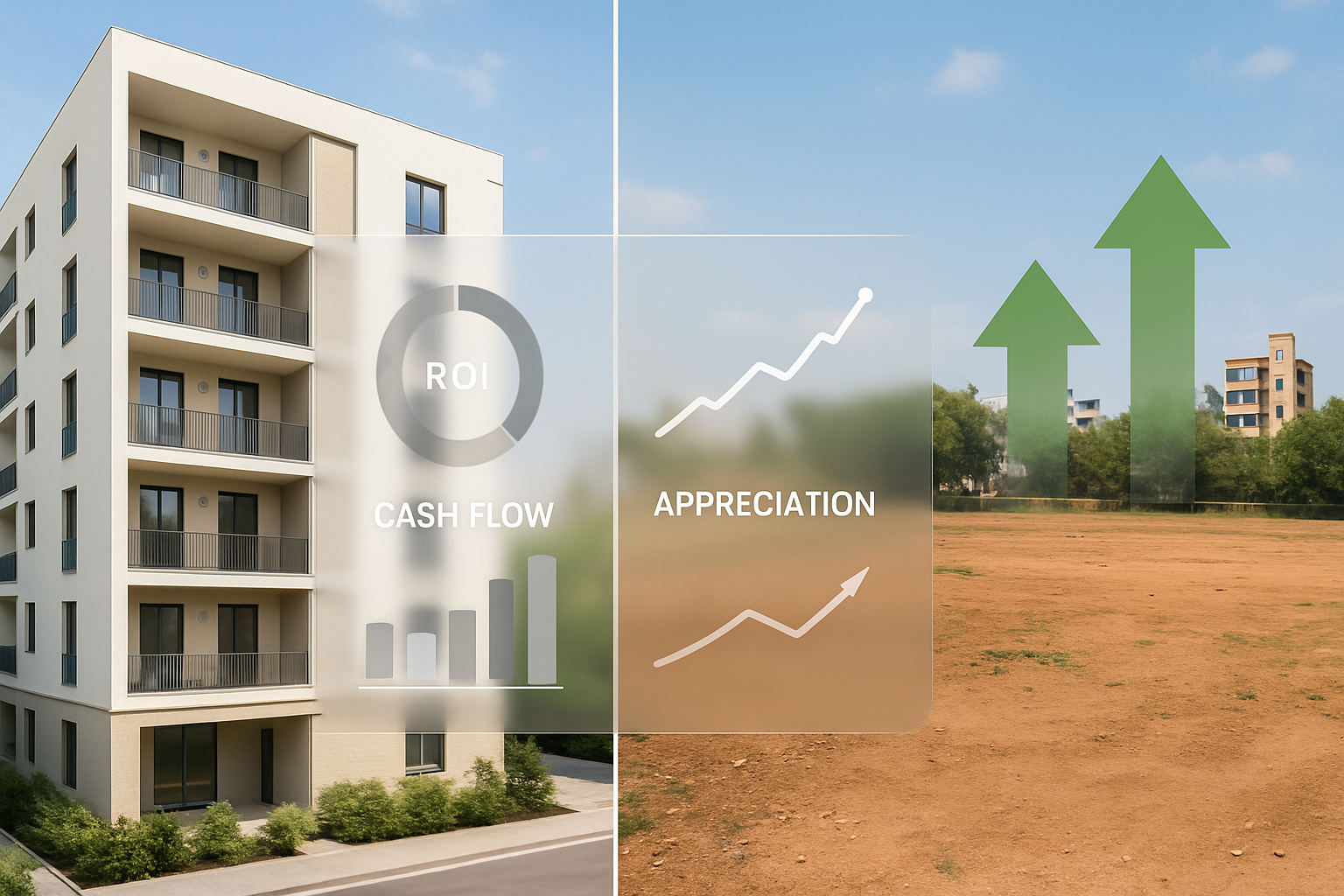
The Core Property ROI Formula You Should Actually Use
Here’s the formula that gives you a real picture:
ROI (%) = [(Annual Rental Income – Annual Expenses + Annual Appreciation) / Total Investment] × 100
Let’s break that down with real numbers.
Say you buy a 2BHK flat in Hyderabad for ₹65 lakhs. You put down ₹20 lakhs and take a loan for ₹45 lakhs. Your total cash invested upfront includes the down payment plus registration (around 7%), so roughly ₹24.5 lakhs.
Annual rental income: ₹36,000 per month = ₹4.32 lakhs per year.
Annual expenses: maintenance (₹15,000), property tax (₹8,000), repairs buffer (₹12,000), vacancy provision for one month (₹36,000), property management if you’re using one (₹25,000). Total expenses: ₹96,000.
Net rental income: ₹4.32 lakhs – ₹96,000 = ₹3.36 lakhs.
Now add appreciation. Conservative estimate for that area: 4% annually on ₹65 lakhs = ₹2.6 lakhs.
Total annual return: ₹3.36 lakhs + ₹2.6 lakhs = ₹5.96 lakhs.
ROI = (₹5.96 lakhs / ₹24.5 lakhs) × 100 = 24.3%
That’s your real return. Not the 6.6% rental yield you’d get if you only divided rent by property value. The difference matters. One makes you think it’s barely worth it. The other shows you’re actually building serious wealth.
How to Calculate Rental Yield vs. Total ROI
Rental yield is simpler. It’s just:
Rental Yield (%) = (Annual Rent / Property Value) × 100
Using the same Hyderabad example: (₹4.32 lakhs / ₹65 lakhs) × 100 = 6.6%.
But rental yield doesn’t tell you much about actual profitability if you’re using leverage. When you take a loan, your cash-on-cash return changes completely because you’re not investing the full property value upfront.
Cash-on-Cash Return = (Annual Cash Flow / Total Cash Invested) × 100
If your annual rental income after expenses is ₹3.36 lakhs, but you’re paying ₹4.2 lakhs in EMIs (₹45 lakh loan at 8.5% for 20 years), your annual cash flow is actually negative: -₹84,000.
Does that mean it’s a bad investment? Not necessarily. You’re still gaining equity through loan principal repayment (around ₹1.4 lakhs in year one) and property appreciation (₹2.6 lakhs). So your actual wealth increase is ₹4 lakhs minus the ₹84,000 cash shortfall = ₹3.16 lakhs annual gain on ₹24.5 lakhs invested = 12.9% ROI.
This is why investors who only look at rental yield miss opportunities. A channel partner in Bangalore told us he avoided plots for years because they generate zero rental income. Then he calculated total ROI including appreciation on a plot he bought in 2019. Turns out it delivered 22% annualized returns over four years. He’s been listing plots actively on Freeperty ever since.
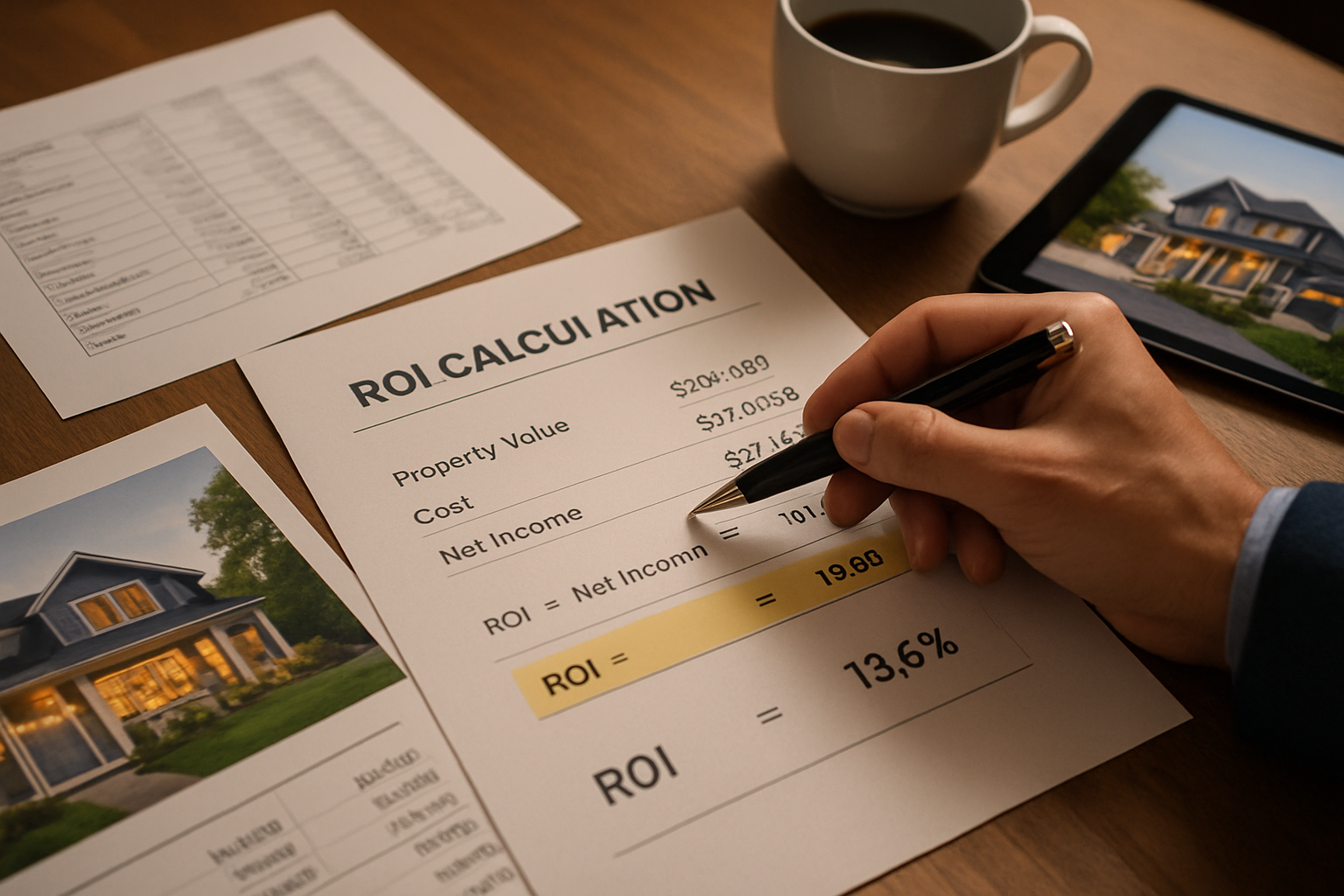
Appreciation Rate—The Number That Changes Everything
Property appreciation isn’t guaranteed. But ignoring it when calculating ROI gives you an incomplete picture. In most Tier 1 and Tier 2 Indian cities, long-term appreciation averages 5-8% annually. Some micro-markets do better. Some worse.
You calculate appreciation impact simply: estimated annual appreciation rate multiplied by current property value. If your ₹65 lakh property appreciates at 5% per year, that’s ₹3.25 lakhs added to your annual return.
But here’s where most people mess up: they assume last year’s appreciation continues forever. Real estate is cyclical. A property in Gurugram that appreciated 12% annually from 2015 to 2019 might have been flat from 2020 to 2022. Your ROI model should use conservative estimates—usually the 10-year average for that micro-market, not the peak year.
We’ve seen this mistake cost NRI investors significantly. They calculate ROI based on the hot growth phase their broker showed them. Three years later, appreciation stalls, rental income hasn’t covered costs, and suddenly their “great investment” is underwater. Conservative appreciation estimates protect you from that.
Tax Benefits and Loan Interest Deductions
If you’re taking a home loan, you get tax deductions on both principal repayment (up to ₹1.5 lakhs under Section 80C) and interest paid (up to ₹2 lakhs under Section 24). For investment properties, you can also deduct municipal taxes and standard deduction of 30% on rental income.
Let’s say your annual home loan interest is ₹3.6 lakhs and you’re in the 30% tax bracket. Your effective tax saving is ₹2 lakhs (interest deduction capped) × 30% = ₹60,000. Add principal repayment deduction: ₹1.5 lakhs × 30% = ₹45,000. Total annual tax benefit: ₹1.05 lakhs.
Add that to your ROI calculation. Your ₹5.96 lakh annual return becomes ₹7.01 lakhs. New ROI: (₹7.01 lakhs / ₹24.5 lakhs) × 100 = 28.6%
Tax benefits alone can add 3-5 percentage points to your real ROI. Most amateur investors leave this money on the table because they don’t track it properly.
Using Freeperty’s Approach to Compare Properties Before You Invest
When you’re comparing multiple properties—say, a rental apartment in Chennai versus a plot in Coimbatore versus a commercial space in Kochi—you need to run ROI calculations on all three. Not just gut feel. Not just what the broker tells you.
This is where Freeperty’s model helps. Because listings are completely free and open, you can browse actual inventory across property types, compare pricing transparently, and model your ROI scenarios without sales pressure. You’re not locked into one broker’s portfolio or one builder’s project.
Here’s how to use it practically: shortlist 4-5 properties that fit your budget. For each one, gather these numbers—purchase price, likely rental income (check comparable listings on Freeperty to verify broker claims), estimated appreciation based on area growth trends, loan terms you’d get, and projected annual expenses. Build a simple spreadsheet. Run the ROI formula for each.
A buyer we worked with in Mumbai did exactly this. She was leaning toward a ready-to-move flat in Andheri because “rental income starts immediately.” But when she ran the ROI math against an under-construction project in Thane with better appreciation potential, Thane came out 6.4 percentage points higher over five years. She went with Thane. Eighteen months later, property values there jumped 11% while Andheri stayed flat. ROI discipline saved her from a mediocre decision.
Common ROI Mistakes That Make Investors Lose Money
Mistake one: Ignoring vacancy periods. If you assume 100% occupancy year-round, your rental income projection is fiction. Realistic model: assume 10% vacancy (roughly one month empty per year). Better to overestimate vacancy and be pleasantly surprised than the reverse.
Mistake two: Underestimating maintenance costs. Property doesn’t maintain itself. Budget at least 1% of property value annually for repairs, upkeep, and eventual renovations. For a ₹50 lakh property, that’s ₹50,000 per year. Most first-time investors budget zero and then get hit with an unexpected ₹80,000 plumbing repair.
Mistake three: Forgetting opportunity cost. That ₹20 lakh down payment could’ve gone into equity mutual funds averaging 12% annually. If your property ROI is only 9%, you’re actually losing relative to the alternative. Always compare real estate ROI to your next-best investment option.
Mistake four: Confusing gross yield with net ROI. Gross rental yield sounds great—8%, 10%, 12%—but it ignores expenses, taxes, loan interest. Net ROI after all costs is what actually matters. A property with 10% gross yield and ₹2 lakh annual expenses might deliver lower net ROI than a 7% gross yield property with minimal costs.
When Low ROI Properties Still Make Sense
Not every property investment needs 20% ROI to be worth it. Sometimes you’re optimizing for different goals—stability, diversification, legacy planning, or just parking black money legally (not that we recommend the last one, but it happens).
If you’re buying a second home in Goa for eventual retirement, ROI might be 4% but lifestyle value is high. If you’re an NRI buying property in your hometown to maintain roots, financial return isn’t the only return. If you’re a developer holding land for long-term project development, short-term ROI is irrelevant—it’s about strategic positioning.
But—and this is critical—you should still know what your ROI is, even if you’re okay with it being low. Ignorance isn’t the same as intentional trade-off. Calculate the number. Then decide if the non-financial benefits justify it.
A property consultant listing through Freeperty told us about a client who bought a farmhouse plot near Lonavala. Rental income: zero. Appreciation: modest, maybe 6% annually. Calculated ROI: 5.8%. But the client uses it every month, hosts family gatherings, and values it at “priceless.” That’s fine. He knew the number and chose lifestyle over maximizing return. That’s informed decision-making, not wishful thinking.
Frequently Asked Questions
What is a good ROI for property investment in India?
Good residential property ROI in India typically ranges from 8% to 15% annually when you include rental income, appreciation, and tax benefits. Commercial properties can deliver 10% to 18%. Anything above 15% for residential is excellent. Below 8%, you’re likely better off in equity or mutual funds unless there are specific strategic reasons for that property.
How do I calculate ROI if I buy property with full cash and no loan?
Use the same formula: (Annual Rental Income – Annual Expenses + Annual Appreciation) / Total Cash Invested × 100. Your cash invested is the purchase price plus registration and other upfront costs. Without a loan, you won’t have EMI payments eating into cash flow, but you also lose leverage benefits and tax deductions on interest. Cash purchases typically show lower ROI percentages because your denominator (total investment) is much higher.
Should I calculate ROI before or after tax deductions?
Both. Calculate pre-tax ROI to understand the property’s raw performance. Then calculate post-tax ROI to see your actual take-home return. The gap between the two shows how much tax efficiency adds to your real wealth creation. For investors in higher tax brackets, this difference can be 3-5 percentage points, which compounds significantly over time.
Does property ROI change over time?
Absolutely. In early years, loan interest is high and tax benefits are significant. As you pay down principal, interest decreases and so do deductions. Meanwhile, rental income usually increases over time, and appreciation hopefully compounds. Smart investors recalculate ROI every 2-3 years to see if holding still makes sense or if selling and redeploying capital would generate better returns elsewhere.
How accurate are online property ROI calculators?
Most are oversimplified. They’ll give you a rough directional sense but often ignore key variables like vacancy rates, actual maintenance costs, property management fees, and opportunity cost. Build your own spreadsheet with real numbers specific to your situation. It takes an hour the first time, then you can reuse the model forever. Tools are helpful for quick estimates, but don’t make a ₹50 lakh decision based on a generic calculator that doesn’t know your tax bracket or local market conditions.
Calculate Before You Commit—Then List Smart
Here’s the reality: most property decisions are emotional first, financial second. You see a flat you like, imagine yourself there, and reverse-engineer the ROI justification afterward. That’s human nature. But it’s expensive human nature.
Flip the process. Run ROI calculations before you fall in love with a property. Set your minimum acceptable return threshold—maybe 10%, maybe 12%, depends on your alternatives. Then only visit properties that clear that bar on paper. You’ll save time, avoid regret, and build a portfolio that actually compounds wealth instead of just looking good.
Whether you’re a first-time investor testing the waters or a channel partner managing client expectations, ROI clarity changes the game. And if you’re listing properties on Freeperty, transparent ROI conversations build trust faster than any sales pitch. Buyers remember the consultant who showed them honest math, not the one who promised fantasy returns.
Ready to Find Properties Worth Calculating ROI For?
You’ve got the formula. You understand the variables. Now you need actual property options to run the numbers on. That’s where Freeperty comes in. Browse thousands of free property listings across India—residential, commercial, plots, rental inventory—with transparent pricing and real details from owners, brokers, and builders. No subscription fees. No hidden costs. Just open access to the market so you can compare, calculate, and invest smarter.
List your property for free on Freeperty if you’re selling or renting. Reach serious buyers who do their homework and know their numbers. Or search for your next investment property with complete visibility across the entire ecosystem. Visit Freeperty today and start building a portfolio based on real ROI, not guesswork.
**