
Most property platforms treat search visibility like an afterthought. They’ll charge you for featured listings, premium subscriptions, or boosted posts—then act surprised when organic inquiries don’t follow. Here’s what we’ve learned running Freeperty: paid visibility doesn’t teach Google to trust you. It just costs money.
Organic property leads come from being found when someone searches. Not from interrupting their scroll. Not from retargeting them across the internet. From showing up in the exact moment they type “2BHK for rent in Baner” or “plots near Lonavala under 20 lakhs” into a search bar. That intent is gold. And it’s completely free to capture if you build for it.
The catch? Most real estate businesses don’t think like search engines. They think like advertisers. They want quick wins, instant visibility, phone calls this week. Organic discovery takes longer. But when it works, it compounds. A property page that ranks keeps generating inquiries months after you list it. A blog post answering a real buyer question pulls leads while you sleep.
We’ve seen individual property listings generate 15 to 20 qualified inquiries over six months—without spending a rupee on ads. We’ve also seen beautifully designed websites that rank for nothing because every page says the same generic thing. The difference isn’t budget. It’s whether you built each page to answer a real search query.
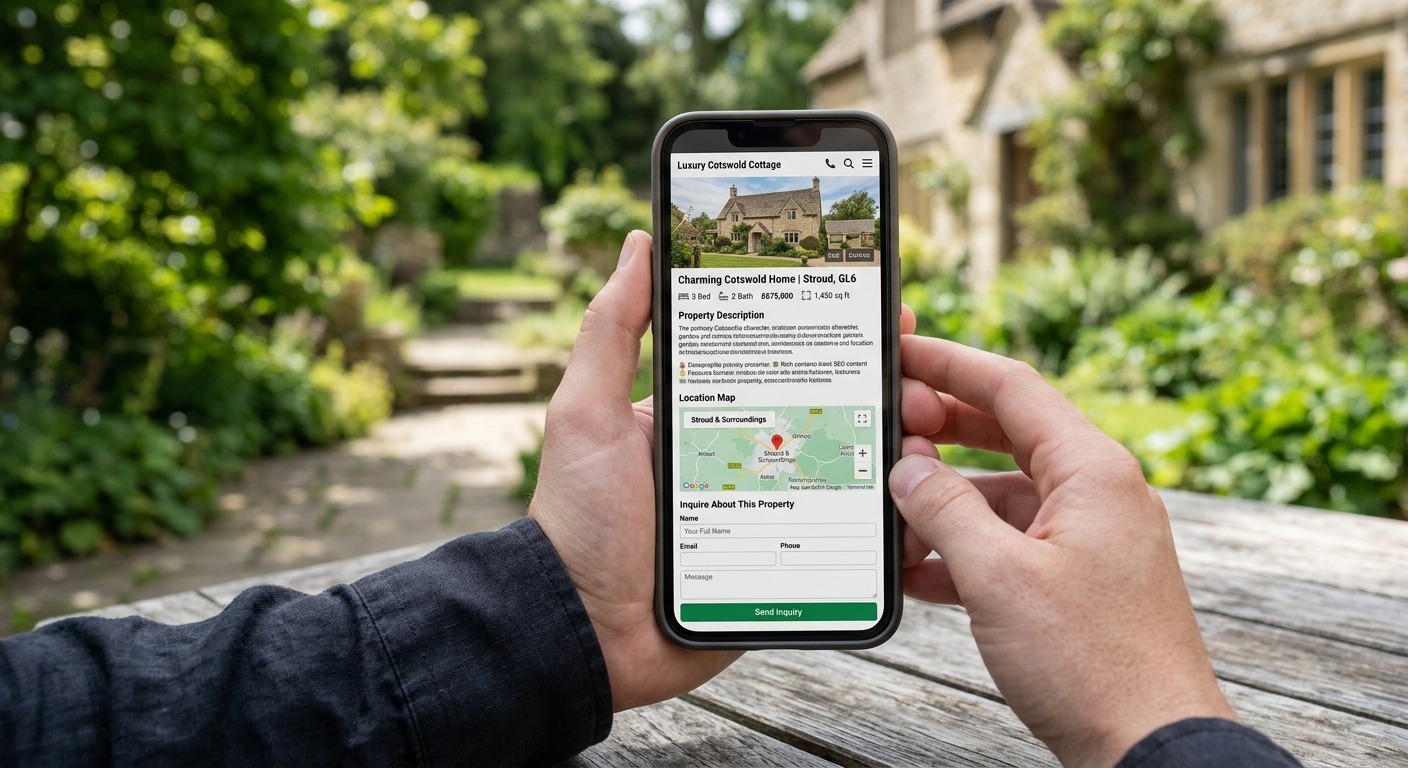
Why Most Property Websites Don’t Generate Organic Leads
Walk through the average real estate website. Beautiful hero images. Sleek carousels. A contact form buried three clicks deep. And almost no text Google can actually rank.
Here’s the problem: search engines can’t rank what they can’t read. If your property pages are just image galleries with “3BHK, ₹85L, call now”—that’s not enough context for Google to decide what search query that page should rank for. A human visitor might understand. A search crawler doesn’t.
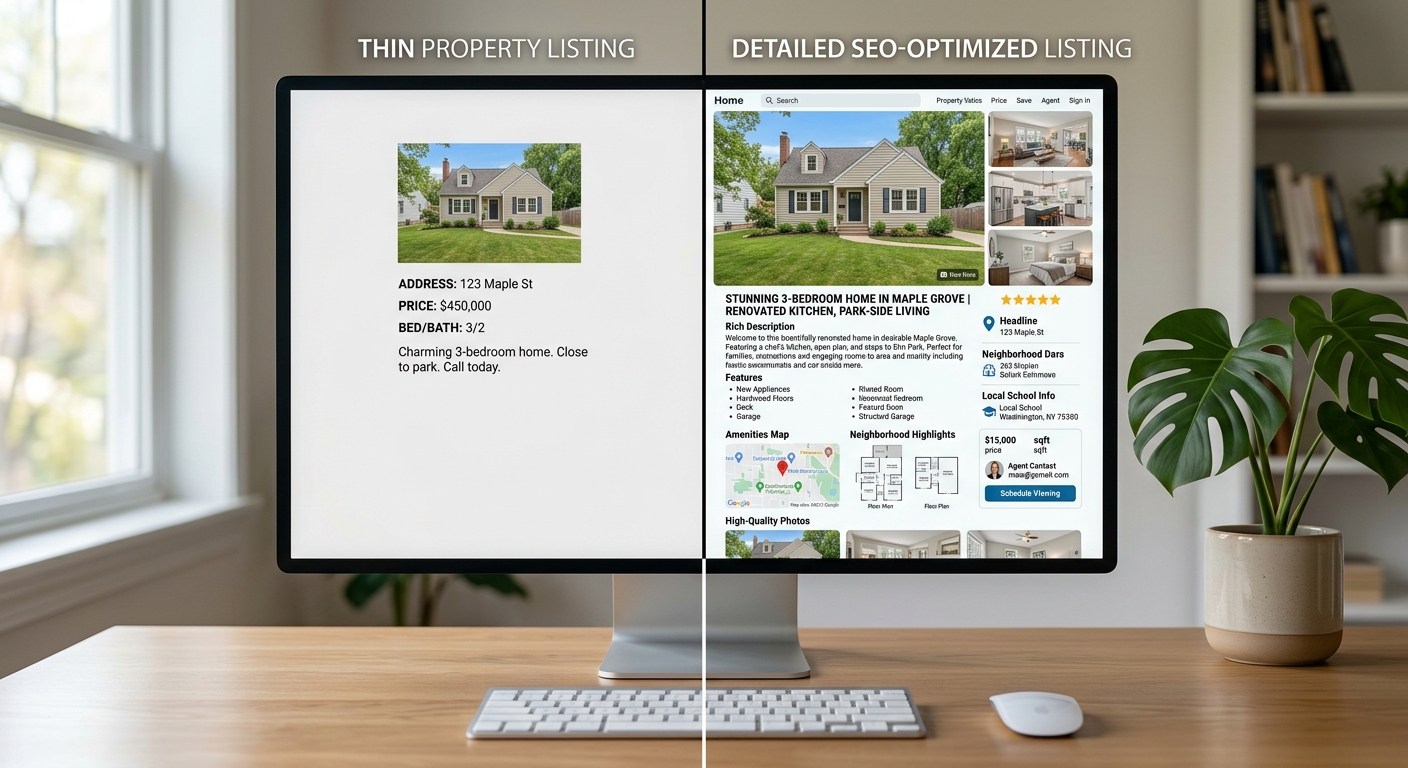
Most platforms also treat every listing the same way. Same template. Same structure. Same thin content. When you do that, Google has no reason to rank one page over another—or to rank any of them at all. There’s no unique value. No depth. Nothing that says “this page deserves to show up when someone searches for property in this specific location.”
Compare that to how content-first platforms work. Each property becomes its own landing page—fully optimized, contextually rich, answering the exact search query a buyer might type. The listing isn’t just a database entry. It’s a piece of search-optimized content designed to pull inbound real estate leads.
That shift—from listing-as-ad to listing-as-content—is the entire game.
What Actually Drives Search-Driven Property Inquiries
Google rewards pages that match user intent. Sounds obvious. Most websites still miss it.
If someone searches “villas in Lonavala for weekend stays,” they’re not just looking for any property. They want weekend homes. Probably with a view. Close enough to Pune or Mumbai for a quick drive. They might care about amenities—pool, garden, privacy. They definitely care about price range and possession status.
A listing that answers all of that—directly, clearly, with real detail—ranks. A listing that just says “villa for sale, call for price” doesn’t. It’s not about keyword stuffing. It’s about actually being useful.
At Freeperty, every property page includes location context, nearby infrastructure, price trends, possession details, and area-specific buyer guidance. Not because it sounds nice. Because that’s what people search for. And when your page is the best answer to their query, Google sends them to you.
The same logic applies to blogs, area guides, and investment explainers. If first-time buyers are searching “how to check property documents before buying,” and you’ve written the clearest guide on that topic, you own that search query. Every person who reads it is a potential lead—even if they don’t convert immediately.
One of our ROI calculator pages ranks for dozens of related search terms. It generates steady traffic month after month. Most of those visitors eventually browse listings. Some reach out. That’s organic lead generation in action—content doing the work long after you publish it.
How to Build Property Pages That Rank and Convert
Start with the listing itself. Treat it like a mini landing page, not a placeholder.
Write a real headline. Not “property for sale in Pune”—that’s too generic. Try “3BHK villa in Bavdhan with home office setup, ₹1.2 Cr” instead. Specific. Searchable. Different from every other listing.
Then add 300 to 500 words of actual description. Talk about the layout, the builder’s track record, the locality’s growth story, what kind of buyer this property suits. Mention the nearest metro station, schools, hospitals. If it’s a plot, explain soil type, corner positioning, road access, and whether RERA approvals are in place.
Include structured details Google loves—price per square foot, possession timeline, furnishing status, parking availability, floor number. These aren’t just nice-to-haves. They’re the data points people filter by. And they’re ranking signals.
Images matter, but not the way most people think. It’s not about how many photos you upload. It’s about tagging each one properly. Use descriptive alt text: “2BHK balcony view overlooking Baner hills” instead of “IMG_4732.jpg.” Google Images is a search channel too. We’ve had inquiries start from image search results.
Every property page on Freeperty gets a unique URL slug, meta title, and meta description. No duplicates. No autogenerated nonsense. If you’re listing 50 properties in the same project, each page still needs to stand on its own. Otherwise Google sees them as near-duplicates and ranks none of them well.
Create Content Around Real Buyer Questions
Property listings pull intent-driven traffic. Content pulls research-phase traffic—people who aren’t ready to buy yet but will be in three months.
That’s where blogs, guides, and area explainers come in. The goal isn’t to go viral. It’s to answer the exact questions your target buyers are typing into Google.
We track search queries that drive traffic to Freeperty. Here’s what actually gets searched: “how to negotiate property price in Pune,” “best areas for plots near Nashik under 10 lakhs,” “NRI property buying process in India,” “difference between carpet area and built-up area.” These aren’t glamorous topics. But they’re what people need to know before they call a broker or visit a site.
So we write for them. Each guide targets one clear query. The structure is simple: answer the question in the first paragraph, expand with examples and context, include a table or checklist if it helps, close with a next step.
One post we published—”how to verify RERA registration before booking a flat”—ranks on page one for several related terms. It links to our listings in RERA-approved projects. Visitors read the guide, trust the advice, and browse inventory. That’s content marketing property that actually works—not fluff disguised as thought leadership.
The mistake most businesses make is writing content for themselves, not for search intent. They publish “why our brokerage is the best” or “10 reasons to invest now”—topics nobody searches for. If you want organic traffic, write for the search bar, not the boardroom.
Why SEO Lead Generation Real Estate Takes Time but Compounds
Here’s the part most founders don’t want to hear: this strategy takes four to six months to show results. Maybe longer if you’re in a competitive market.
Google doesn’t rank new pages immediately. It takes time to crawl, index, evaluate authority, and decide where your content fits. Early traffic will be low. You’ll second-guess the effort. You’ll be tempted to go back to paid ads because at least those produce calls this week.
But here’s what happens if you stay consistent. Month three, a few posts start ranking on page two. Month five, one of them hits page one. Month seven, you’re getting 20 to 30 organic inquiries a week across your content and listings. By month twelve, older content is still pulling leads while newer posts gain traction.
That compounding effect is why organic property leads beat paid leads long-term. An ad stops working the minute you stop paying. A ranked page keeps working as long as it stays ranked—and if you maintain it, that can be years.
We’ve had property pages generate inquiries 18 months after the original listing date. The seller had already moved on, but the page ranked so well we repurposed it as an area guide. Still pulls traffic. Still drives leads to similar inventory.
The ROI isn’t immediate. But once it kicks in, it’s hard to beat. No cost per click. No bidding wars. Just search traffic converting into calls and site visits.
Use Tools That Help You Rank, Not Just Track Vanity Metrics
You can’t optimize what you don’t measure. But most real estate businesses measure the wrong things.
Page views don’t matter if none of those visitors fill a form. Bounce rate doesn’t tell you much if people found what they needed and left happy. Time on page is interesting but not actionable unless you know which pages convert.
Start with Google Search Console. Free tool, directly from Google. Shows you which queries your site ranks for, which pages get clicks, and where you’re stuck on page two. If a page ranks position 11 for a valuable keyword, that’s low-hanging fruit—improve the content slightly and you might jump to page one.
Use something like Ahrefs or SEMrush if you can afford it. These tools show competitor rankings, backlink profiles, keyword difficulty, and content gaps. We use them to find queries our competitors aren’t targeting well—then write better content for those searches.
Track leads, not just traffic. Set up goal tracking in Google Analytics 4 so you know which pages and posts actually generate inquiries. A blog post with 500 visits and 3 leads is more valuable than one with 2,000 visits and zero conversions. Optimize for the former.
And don’t obsess over keyword rankings alone. A page can rank #1 and still convert poorly if the content doesn’t match real buyer intent. The goal is search-driven property inquiries that turn into site visits and deals—not just seeing your name on page one.
Where Most Real Estate SEO Strategies Fail
We’ve seen agencies pitch SEO packages to property businesses. Lots of them sound good on paper. Most fail in execution.
Here’s why: they optimize for the wrong keywords. They’ll target “real estate in India” or “buy property online”—massive search volume, zero intent. Ranking for those terms doesn’t help if the visitor isn’t actually in your city or price range.
Better to rank #1 for “3BHK flats in Wakad under 80 lakhs” than #8 for “property in Pune.” The former brings 10 qualified leads. The latter brings 100 irrelevant clicks.
Another failure mode: outsourcing content to writers who’ve never bought property. The content reads fine but misses critical nuance. A first-time buyer searching “should I buy under-construction or ready-to-move flat” needs a real breakdown of payment schedules, possession risk, GST implications, and resale liquidity. Generic advice doesn’t cut it.
We write every guide internally or with contributors who’ve actually worked in real estate. If the writer hasn’t closed a deal, negotiated with a builder, or walked a buyer through RERA registration, their content won’t resonate with someone who’s about to make a ₹50 lakh decision.
And then there’s the biggest mistake: building SEO content on a separate blog subdomain, divorced from actual listings. Your blog is on blog.yoursite.com. Your properties are on listings.yoursite.com. Google treats them as separate entities. Internal linking is weak. Authority doesn’t transfer.
Keep everything on one root domain. Blog posts link to relevant properties. Property pages link to helpful guides. That’s how search authority flows through the site and lifts rankings across the board.
What Freeperty’s Model Teaches About Organic Discovery
Running a free property marketplace taught us something most paid platforms never learn: when you remove paywalls, you create more inventory. When you have more inventory, you can build more content. When you have more content, you rank for more queries. When you rank for more queries, you attract more buyers. And more buyers attract more sellers.
It’s a flywheel. But it only works if search is built into the model from day one.
Every property listed on Freeperty becomes a unique, indexable page with full SEO treatment. No two pages look identical. No thin content. No “call for details” cop-outs. Each listing stands alone as a potential entry point from Google.
We also publish area guides, investment explainers, and buyer education content. Not to fill a blog quota. Because those topics pull traffic from people earlier in the funnel—researchers, comparison shoppers, first-timers who don’t even know which locality to target yet.
Some of that traffic converts immediately. Most of it doesn’t. But it builds awareness, trust, and return visits. When that researcher is ready to buy six months later, Freeperty is the platform they remember. That’s the long game of content marketing property that most businesses quit too early to see.
We’re not the only ones who can do this. Any real estate business—agent, broker, developer, portal—can build the same engine. You just need to treat content as infrastructure, not marketing fluff. And you need to be patient enough to let Google’s algorithm do its work.
Turning Organic Traffic Into Actual Inquiries
Ranking is half the battle. Converting that traffic is the other half.
A visitor lands on your property page from search. Now what? If your contact form is buried, your phone number is missing, or your CTA is vague, they’ll leave. Most do.
Make inquiry friction as low as possible. Phone number visible in the header. WhatsApp click-to-chat if that’s how your market communicates. A simple form—name, phone, message—nothing more. Don’t ask for their budget, timeline, and preferred possession date before they’ve even spoken to you.
We tested this on Freeperty. A four-field form converted 40% worse than a two-field form. Buyers don’t want to fill out a survey. They want to ask a question. Let them.
Also, respond fast. If someone submits a query at 11 a.m. and you reply at 6 p.m., you’ve lost the lead. They’ve already called two other brokers. Speed matters more in real estate than most industries because the consideration set is wide and switching costs are zero.
Set up instant notifications—email, SMS, Slack, whatever ensures you see the inquiry within five minutes. Even an auto-reply acknowledging the message and promising a callback buys you credibility.
And here’s a nuance most miss: organic leads behave differently than paid leads. Paid leads expect a sales pitch—they clicked an ad, they know what’s coming. Organic leads are often still researching. They found your content, not your ad. If you jump straight into closing mode, you’ll scare them off.
Start consultative. Ask questions. Understand their timeline. Offer resources. Build trust before you push a site visit. The conversion cycle is longer, but the lead quality is often better. They found you, not the other way around.
FAQ
How long does it take to see results from SEO lead generation real estate?
Expect four to six months before meaningful organic traffic builds. Google needs time to crawl, index, and rank your content. Early results will be slow. Month six onwards, if you’ve published consistently and optimized properly, inbound real estate leads start flowing steadily. Patience is non-negotiable in organic search.
Can small brokers compete with big portals for organic property leads?
Yes, but not head-on. Big portals rank for broad terms like “property in Mumbai.” You won’t outrank them there. Instead, target hyper-local queries: “2BHK in Thane West under 1 crore” or “plots near Karjat with RERA approval.” Lower volume, higher intent, less competition. Dominate the long-tail and you’ll generate quality leads big platforms ignore.
What’s the difference between organic and paid property leads?
Organic property leads find you through search—blogs, guides, or listings that rank. They’re researching, have high intent, and didn’t cost you per click. Paid leads come from ads—faster to generate but stop the moment you stop spending. Organic compounds over time. Paid doesn’t. Both have a role, but organic builds long-term equity.
Do I need to hire an agency or can I do SEO lead generation in-house?
You can do it in-house if you’re willing to learn. Use free tools like Google Search Console and keyword research plugins. Write content yourself—you know your market better than any hired writer. Start small: optimize existing listings, publish one guide per week, track what ranks. Agencies help if you need scale or technical fixes, but the strategy isn’t rocket science.
Start Building Your Organic Lead Engine Now
You don’t need a massive budget to generate organic property leads. You need a search-first mindset, consistent content creation, and the patience to let compound growth work.
Start with your existing listings. Rewrite the descriptions. Add location context. Optimize titles and meta tags. Then publish one buyer guide per week—answer real questions your audience is searching for. Use tools like Google Search Console to find gaps and opportunities. Track which pages convert, not just which ones rank.
If you’re listing properties and want every page to work as hard as possible, Freeperty’s model shows what’s possible when SEO is baked into the platform. No subscription fees. No pay-per-listing gates. Just a marketplace where every property gets full search visibility and every visitor can browse freely. That’s how you build trust and momentum in organic discovery.
Ready to see how search-driven property inquiries can replace paid lead dependency? Visit Freeperty, list your inventory, and let your properties start working for you in search results. The traffic is already searching. You just need to show up where they’re looking.