
A couple from Navi Mumbai called us in March 2026. They’d been tracking a 2BHK in Kharghar for six months — listed at ₹1.02 crore in October 2025. By February, it was ₹1.08 crore. Same flat, same floor, same negotiation-resistant broker. They’d assumed the seller was just greedy. Turns out, the entire corridor had shifted. Not speculation — actual transaction registrations had jumped 4.7% in Q4 2025 across Navi Mumbai’s node areas, driven by metro connectivity updates and IT park expansion announcements. The seller wasn’t being difficult. The market had genuinely moved.
That story isn’t unique to Mumbai. Across India’s top three metros — Mumbai, Bangalore, and Pune — property price trends in 2026 are less about blanket appreciation and more about hyper-local shifts driven by infrastructure updates, employment density changes, and supply-demand imbalances in specific micro-markets. If you’re comparing these cities to decide where to buy, invest, or list property, the aggregate city-level numbers will mislead you. What matters now is which corridor, which property type, and which quarter you’re tracking.
Here’s what we’ve seen working directly with property owners, brokers, and channel partners listing thousands of properties on Freeperty across these three metros. This isn’t textbook analysis. It’s ground-level observation from people actually transacting — and the patterns are sharper than most reports admit.
Mumbai Real Estate in 2026: Price Growth Driven by Scarcity, Not Demand
Mumbai’s property market doesn’t follow normal rules. It never has.
The headline number most reports cite — 5 to 6% YoY appreciation across the city — hides the real story. Central Mumbai and parts of the Western Suburbs have seen almost flat pricing or marginal dips in Q1 2026, especially in mid-tier resale inventory. Developers aren’t cutting launch prices, but resale sellers in Andheri, Malad, and Goregaon are holding stock longer. Buyers have more negotiating room than they did a year ago.
Meanwhile, Navi Mumbai and Thane — the extended metropolitan region — are seeing sharper, steadier price growth. Not because demand is stronger. Because supply is tighter in ready-to-move-in stock, and because the metro and coastal road projects have compressed perceived distance. A flat in Kharghar or Dombivli that took 90 minutes to reach SoBo in 2023 now takes 50. That psychological shift is worth 4 to 5% in valuation, even if the neighbourhood itself hasn’t fundamentally changed.
We’ve listed properties in both zones on Freeperty, and the behaviour difference is stark. Central Mumbai listings get more views, longer consideration cycles, and slower closures. Navi Mumbai and Thane listings convert faster — buyers aren’t shopping, they’re deciding between two or three options and moving. That urgency shows up in price firmness.
Commercial real estate in Mumbai is a different animal entirely. Office spaces in BKC, Lower Parel, and Worli are seeing rental yield compression — not because rents are falling, but because capital values have run ahead of income potential. If you’re buying commercial property in Mumbai in 2026 for yield, the math is tougher than it was two years ago. If you’re buying for long-term capital appreciation and tenant quality, it still makes sense — but only in Grade A stock.
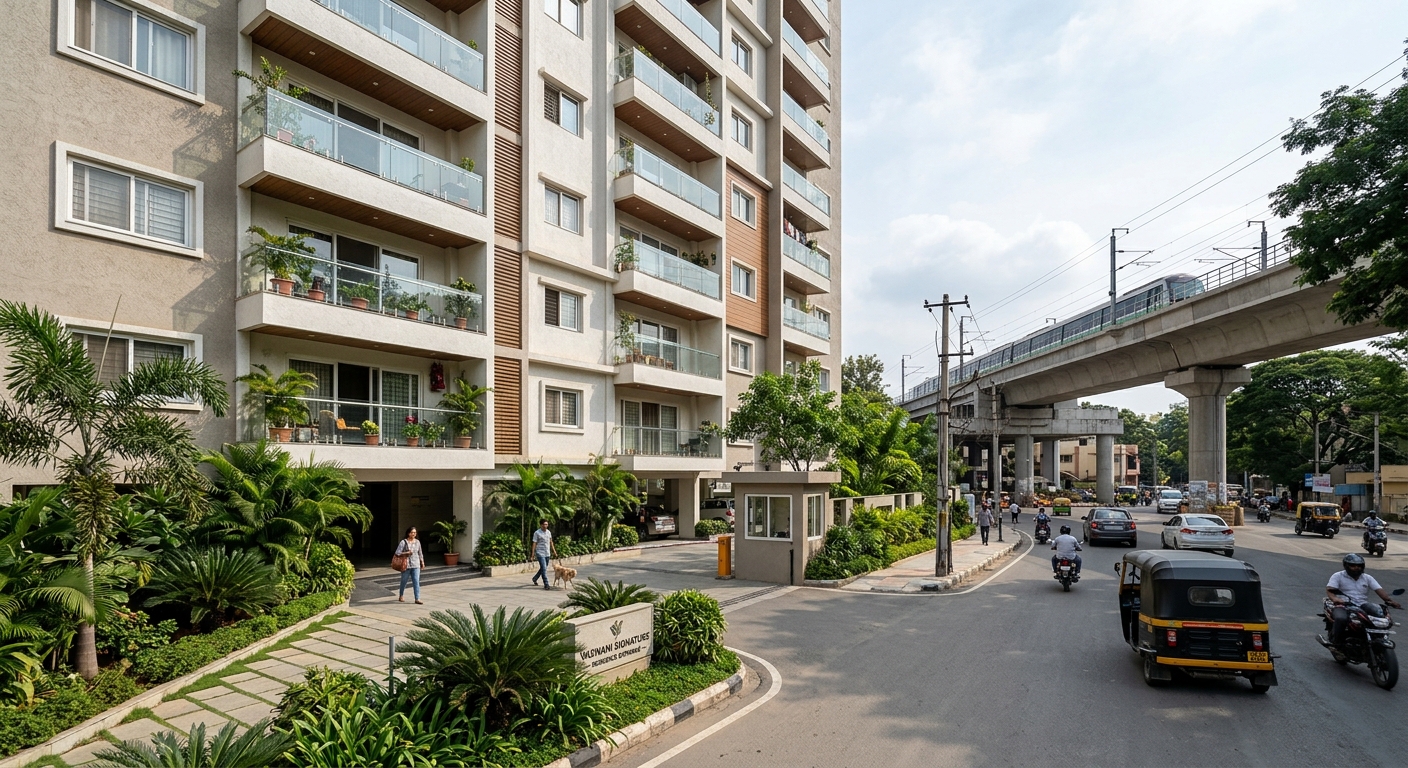
Bangalore Housing Market 2026: The IT Corridor Recalibration
Bangalore’s property price trends in 2026 are the most regionally fragmented of the three cities.
Whitefield, once the undisputed growth leader, has cooled. Not crashed — cooled. Prices are holding, but momentum has shifted. New launches are moving slower, and resale inventory has thickened. We’ve seen properties listed on Freeperty in Whitefield sit for 60 to 90 days without serious enquiries, something that would’ve been unusual in 2024. The issue isn’t pricing. It’s that buyers have more options now, and they’re pickier about project reputation, possession timelines, and builder track record.
North Bangalore — particularly Devanahalli, Yelahanka, and the airport corridor — is absorbing that demand. The airport metro extension and the upcoming Aerospace Park have made this zone the new Whitefield in terms of buyer interest. Price growth here in late 2025 and early 2026 has been 6 to 8% in pockets close to metro stations and major employment hubs. That’s faster than the city average, and it’s being driven by actual end-users, not just investors.
South Bangalore remains expensive and stable. Koramangala, HSR Layout, JP Nagar, and Bannerghatta Road aren’t seeing sharp spikes, but they aren’t softening either. This is Bangalore’s version of Mumbai’s SoBo — established, liquid, and relatively immune to sentiment swings. If you’re listing property here, you’ll get enquiries. If you’re buying, you’ll pay full price.
One thing we’ve noticed working with channel partners in Bangalore: rental yields are under pressure across the board. The city’s residential rental market hasn’t kept pace with capital value growth, especially in mid-tier 2BHK and 3BHK segments. Buyers who assumed 3 to 4% gross yields are now seeing 2.5 to 3%, and that’s before maintenance and vacancy adjustments. If you’re buying in Bangalore purely for rental income in 2026, the numbers don’t justify it unless you’re in a premium micro-market with strong corporate tenant demand.
Pune Property Rates 2026: The Tier-2 Metro That Stopped Being Tier-2
Pune’s property market in 2026 is behaving less like India’s education and auto hub and more like Bangalore circa 2018.
The city’s residential property prices have grown 7 to 9% YoY in select corridors — faster than both Mumbai and Bangalore on a percentage basis. That sounds aggressive, but the base was lower. A 3BHK in Hinjewadi Phase 1 that cost ₹85 lakh in early 2025 is now moving closer to ₹92 to 95 lakh in comparable projects. The appreciation is real, transaction-backed, and driven by a mix of IT sector expansion, reverse migration from Bangalore (we’ve spoken to at least a dozen families who moved back), and better infrastructure delivery than most expected.
Hinjewadi, Wakad, and Baner continue to lead. These aren’t emerging areas anymore — they’re established. New supply is being absorbed quickly, especially in the ₹70 lakh to ₹1.2 crore range, which is Pune’s sweet spot for salaried buyers. Developers are launching at higher base prices than they did 18 months ago, and they’re not offering the kind of discounts or freebies that were common in 2022 and 2023.
What’s interesting is the secondary growth in areas like Kharadi, Wagholi, and even parts of Undri and Kondhwa. These used to be the “compromise” locations — where you bought if you couldn’t afford Hinjewadi or Baner. In 2026, they’re not compromises anymore. They’re choices. Kharadi, especially, has matured into a self-contained micro-market with employment, schools, retail, and decent connectivity. Prices here have firmed up, and inventory is moving.
Pune’s plot and villa market is also seeing unusual traction. We’ve listed farmland plots, NA plots, and villa projects on Freeperty in areas like Mulshi, Lonavala outskirts, and Saswad, and the enquiry quality has surprised us. Buyers aren’t just asking — they’re visiting, doing due diligence, and closing. This wasn’t happening two years ago. The weekend-home and land-banking mentality has revived, and Pune’s proximity to both Mumbai and its own green belt makes it a natural beneficiary.

Supply and Demand Imbalances: Where the Real Pressure Points Are
Across all three cities, the biggest driver of property price trends in 2026 isn’t demand growth — it’s supply lag.
Developers slowed launches significantly in 2023 and early 2024. Land acquisition costs rose, approval timelines stretched, and construction financing got expensive. The result is that ready-to-move-in inventory in the mid-segment (₹60 lakh to ₹1.5 crore) is tight in all three metros. Under-construction inventory is available, but post-pandemic buyers are possession-focused. They don’t want 2028 handover timelines. They want keys in six months.
That mismatch is showing up as price firmness in resale stock and new ready inventory, and as buyer hesitation in pre-launch and early-stage projects. In Mumbai, this gap is most visible in the ₹1 to 2 crore segment in suburbs. In Bangalore, it’s the ₹80 lakh to 1.5 crore range in North and East Bangalore. In Pune, it’s across the board in anything close to IT corridors.
For property owners listing on platforms like Freeperty, this creates opportunity. If your property is ready to move in, priced realistically for the current market, and in a location with decent connectivity, you’ll get enquiries. The challenge isn’t visibility anymore — SEO-driven discovery means every listing becomes a searchable landing page. The challenge is conversion, which comes down to documentation readiness, realistic pricing, and responsiveness.
We’ve seen sellers lose deals not because their property wasn’t good, but because they took three days to respond to an enquiry or couldn’t produce a clear title report when asked. In a tight inventory market, buyers move fast. If you’re not ready, someone else’s listing is.
Investment vs End-User Behaviour: The Divide is Widening
One pattern we’ve tracked closely in 2026: investor behaviour and end-user behaviour are diverging more than they used to.
Investors — especially NRIs and HNIs — are still active, but they’re choosier. They’re not buying every new launch in every location. They’re concentrating on liquid micro-markets with proven rental demand or capital appreciation track records. In Mumbai, that’s still Navi Mumbai, Thane, and pockets of Central Mumbai. In Bangalore, it’s North Bangalore and parts of South Bangalore. In Pune, it’s Hinjewadi and Baner.
End-users, on the other hand, are spreading out. They’re willing to consider locations that investors ignore, because they’re optimising for livability, commute time, school proximity, and budget — not just resale value. This has created a two-tier market in each city. Tier one is where both investors and end-users compete, which keeps prices firm. Tier two is where only end-users buy, which keeps price growth moderate but steady.
From a listing and discovery perspective, this matters. If you’re selling a property in a tier-one micro-market, you’ll get enquiries from both segments, and you can price accordingly. If you’re in a tier-two area, your buyer is likely an end-user, and your pricing, messaging, and responsiveness need to reflect that. End-users ask different questions. They care about possession timelines, loan approvals, proximity to schools and hospitals, and society maintenance quality. Investors care about rental yield, capital appreciation potential, and exit liquidity.
Freeperty’s open marketplace model works well here because it brings together all stakeholder types — owners, brokers, channel partners, developers — and lets buyers filter by what matters to them. You’re not pitching to a platform algorithm. You’re being discovered by people actively searching for properties in your location and price range.
Price Trends by Property Type: Not All Assets Move Together
Residential flats dominate transaction volume across all three cities, but 2026 is seeing sharper differentiation by property type.
Plots and land parcels are appreciating faster than flats in Pune’s outskirts and parts of North Bangalore. This isn’t speculation — it’s driven by actual buyers planning self-construction or land banking for future villa development. We’ve listed NA plots on Freeperty in areas like Chakan, Talegaon, and Devanahalli, and the enquiry-to-visit conversion rate is higher than we expected. Land is illiquid by nature, but when it moves, it moves at a premium to last transacted rates.
Villas and independent houses are seeing a mini-revival, especially in Pune and Bangalore. Buyers who would’ve settled for a 3BHK flat in 2023 are now stretching budgets to get a villa or row house in a gated community. This shift is partly lifestyle-driven (post-pandemic preferences haven’t fully reversed) and partly availability-driven (good villa inventory is limited). Prices for villas in areas like Sarjapur, Whitefield, Hinjewadi, and Baner have appreciated 6 to 10% in the past year, outpacing comparable flat inventory.
Commercial property is a mixed story. Office spaces in premium locations are stable to slightly up. Retail is recovering but uneven — high street retail in established areas is doing well, while mall-based retail outside core zones is struggling. Warehousing and industrial property on city outskirts — especially near Pune, Mumbai’s extended region, and Bangalore’s peripheral industrial belts — is seeing strong demand and price growth driven by logistics and e-commerce sector expansion.
For sellers and listers, the takeaway is simple: don’t assume your property type will follow the city average. Plot prices in Talegaon might be up 12% while flat prices in the same area are up 4%. Villa prices in Sarjapur might be up 9% while flats in Whitefield are flat. Market the asset for what it is, not what the city headline says.
What Listings Data on Freeperty Tells Us About Buyer Behavior
We’ve seen over 50,000 property listings go live on Freeperty across these three metros in the past year. The behavioral data is instructive.
Search activity spikes between 8 PM and 11 PM on weekdays, and between 10 AM and 4 PM on weekends. Buyers are researching in their own time, not during work hours. That means your listing needs to be complete, visual, and informative enough to hold attention without a phone call. If your description is two lines and you have three photos, you’re losing 70% of potential enquiries before they even contact you.
Location-specific search is intensifying. Buyers aren’t searching “property in Bangalore” anymore. They’re searching “3BHK in Yelahanka under 80 lakh” or “2BHK resale flat in Baner with possession.” The more specific your listing tags, title, and description, the better your discovery. Freeperty’s SEO-driven model rewards specificity — every property page is a landing page, and Google ranks pages that answer searcher intent clearly.
Price range matters more than exact price. A property listed at ₹95 lakh gets more visibility than one listed at ₹99 lakh, because buyers filter by range (₹80 lakh to ₹1 crore vs ₹1 crore to ₹1.2 crore). If you’re pricing near a threshold, think carefully about where you land. A 4% difference in list price can mean a 40% difference in search visibility.
Response time is everything. Enquiries that get a response within two hours have a 60% higher chance of converting to a site visit than those answered the next day. Buyers are comparing multiple properties simultaneously. If you’re slow, they’ve already moved on.
Rental Yields and ROI Reality Check: The Math in 2026
Let’s talk numbers plainly.
If you’re buying property in Mumbai, Bangalore, or Pune in 2026 expecting 4 to 5% gross rental yield, you’ll be disappointed in most segments. Rental yields across these metros are compressing because capital values have appreciated faster than rents.
In Mumbai’s suburbs, expect 2 to 2.5% gross yield on residential property. In Navi Mumbai and Thane, slightly better — 2.5 to 3%. Premium locations in South Mumbai or BKC might touch 2% if you’re lucky. The only exception is small-format studio apartments or co-living setups in high-demand rental pockets, which can yield 3.5 to 4%, but those come with higher tenant turnover and management hassle.
Bangalore’s rental yields are marginally better but still modest. North Bangalore and parts of East Bangalore can deliver 3 to 3.5% gross yield if you’re in the right pocket and property type. South Bangalore is closer to 2.5%. Whitefield is 2.5 to 3%, depending on project quality and tenant segment.
Pune offers the best rental yields of the three cities, largely because capital values haven’t run as far ahead. Hinjewadi, Kharadi, Wakad, and Baner can still deliver 3 to 4% gross yield on well-located 2BHK and 3BHK inventory. That’s before taxes, maintenance, and vacancy — so net yield is closer to 2 to 3% — but it’s better than the other two metros.
Capital appreciation is where the real return sits in 2026. If you’re buying for income, think twice. If you’re buying for long-term wealth creation and can hold for 5 to 7 years, the math works — but only if you’re in the right micro-market. The city average won’t save a bad location choice.
Infrastructure Updates and Their Price Impact: What Actually Moved Markets
Every city claims infrastructure will drive prices. Most of the time, it doesn’t — or it takes so long that early buyers lose patience.
But in 2026, we’ve seen a few genuine infrastructure-driven price shifts worth noting.
Mumbai’s coastal road and metro line extensions have compressed travel time and psychological distance. Areas like Malad, Borivali, and even Vasai that once felt “too far” now feel accessible. Price growth hasn’t been explosive, but it’s been steady — 4 to 6% in the 12 months following connectivity improvements. That’s real, transaction-backed movement, not hype.
Bangalore’s airport metro line and the upcoming Peripheral Ring Road (PRR) have had the most visible impact. North Bangalore’s price jump in 2025 and early 2026 is directly tied to these projects. Buyers believe the connectivity story now, whereas two years ago it was still speculative. Once a metro station opens and people actually use it, sentiment shifts. Prices follow.
Pune’s metro Phase 1 completion and the Pune-Mumbai Expressway upgrades have made the city more accessible both internally and externally. This has supported price growth in the ₹70 lakh to ₹1.2 crore segment, which is heavily salaried-buyer driven. Better commute times mean buyers can consider locations they previously ruled out, which broadens demand and supports pricing.
The lesson: infrastructure impacts prices when it’s delivered and functional, not when it’s announced. If you’re buying based on a proposed project, build in a 3 to 5 year lag before you see price impact. If you’re buying near a just-opened metro station or expressway, you’ve likely missed the steepest appreciation, but you’ll benefit from liquidity and stable demand.
Should You Buy, Sell, or Wait in 2026?
There’s no universal answer, but here’s the framework we use when advising buyers and sellers on Freeperty.
Buy if:
- You’re an end-user who’s found the right property in the right location at a price you can afford without stretching beyond 40% of monthly income for EMI.
- You’re buying ready-to-move-in inventory in a liquid micro-market where you’re comfortable holding for at least five years.
- You’re okay with 2 to 3% rental yield and are buying primarily for capital appreciation and long-term wealth creation.
- You have cash reserves beyond your down payment for furnishing, maintenance, and unexpected costs.
Sell if:
- Your property is in a micro-market that’s peaked or plateaued, and you have a better investment or personal use for the capital.
- You’ve held the property for 5+ years, seen decent appreciation, and don’t want to manage tenants or deal with maintenance anymore.
- You’re selling to upgrade or relocate, not because you’re trying to time the market top.
Wait if:
- You’re stretching financially to buy and have no cash buffer post-purchase.
- You’re buying purely for rental yield and expecting 5%+ gross returns — you won’t find them in these metros in 2026.
- You’re speculating on under-construction inventory in unproven locations hoping for quick flips — that playbook hasn’t worked since 2017.
- You’re a seller in a slow micro-market expecting 2024 pricing — the market has moved, and overpricing just means longer listing cycles and eventual price cuts.
Frequently Asked Questions
Which city has the best property price growth potential in 2026 — Mumbai, Bangalore, or Pune?
Pune is showing the strongest percentage growth in 2026, with 7 to 9% YoY appreciation in key corridors like Hinjewadi, Wakad, and Kharadi. Bangalore’s North corridor is growing 6 to 8%, while Mumbai’s growth is more segmented — 4 to 5% in suburbs, stronger in Navi Mumbai and Thane. Best potential depends on your budget, property type, and investment horizon.
Are property prices in Bangalore falling in 2026?
No, Bangalore property prices aren’t falling overall in 2026, but growth has slowed in previously hot micro-markets like Whitefield. North Bangalore and the airport corridor are seeing stronger appreciation, while South Bangalore remains stable. Price correction is localized to specific projects with delivery delays or builder reputation issues, not a citywide trend.
Is now a good time to invest in Mumbai real estate?
Mumbai real estate in 2026 offers stability rather than explosive growth. If you’re buying in Navi Mumbai, Thane, or well-connected suburbs with ready possession and realistic pricing, it’s a reasonable long-term hold. Expect modest capital appreciation and low rental yields. Avoid overpriced under-construction inventory in unproven pockets.
What is the average rental yield in Pune in 2026?
Average gross rental yield in Pune in 2026 ranges from 3 to 4% in high-demand areas like Hinjewadi, Kharadi, Wakad, and Baner. This is better than Mumbai (2 to 2.5%) and Bangalore (2.5 to 3.5%), largely because Pune’s capital values haven’t run as far ahead of rental income. Net yields after taxes and maintenance are closer to 2 to 3%.
Ready to List or Discover Property Across India’s Top Metros?
If you’re comparing property price trends across Mumbai, Bangalore, and Pune to decide where to buy, sell, or invest in 2026, the most important thing you can do is get your property in front of the right buyers — or find the right inventory if you’re searching.
Freeperty is India’s completely free property listing and discovery platform. No subscription fees, no hidden charges, no gated access. Whether you’re an owner, broker, channel partner, or developer, your listings get full SEO-driven visibility, turning every property into a searchable landing page. If you’re a buyer, you get access to the entire marketplace — residential, commercial, plots, villas — with advanced filters by location, price, property type, and possession timeline.
List your property on Freeperty today or start your search. Real visibility, real choice, zero cost.