
You’ve saved for years. Maybe a decade. You’re ready to invest back home — buy that plot in Pune, that apartment in Bangalore, or that farmhouse just outside Goa. The bank balance is there. The intent is strong. But the checklist? That’s where most NRI property investments trip up before the ink on the sale deed even dries.
We’ve worked with dozens of NRIs at Freeperty who walked into property deals with strong financial backing but weak ground-level intelligence. The ones who succeeded didn’t just have more money. They had a better checklist. And they knew which questions to ask before the broker started showing property photos.
Here’s the thing — NRI property investment India isn’t just about sending money through the right banking channel. It’s about knowing what happens after the wire transfer clears. It’s about documentation no one mentions until it’s missing. It’s about local taxes that show up two years later. And it’s about making sure the property you’re buying actually exists the way it’s being sold.
This isn’t theory. This is the checklist we wish every NRI had before they clicked “confirm payment.”
Why NRIs Get Burned More Often Than Local Buyers
Distance changes everything. When you’re investing from Dubai, Singapore, or New York, you can’t drive to the site on a Tuesday afternoon. You can’t drop by the municipal office to verify approvals. You can’t smell when something’s off.
That gap? Sellers know it exists. The good ones respect it. The bad ones exploit it.
We’ve seen cases where an NRI bought agricultural land listed as “convertible” — only to discover that conversion approval was pending for seven years and still stuck in committee. The broker sent photos. The price looked fair. The location checked out on Google Maps. But the paperwork? It was a polite fiction.
Local buyers would’ve caught that in week one. NRIs found out after full payment. That’s the cost of distance — and exactly why due diligence isn’t optional for you. It’s survival.

The Pre-Search Checklist: What to Lock Down Before You Even Browse Listings
Most NRIs start backwards. They browse properties, fall in love with a sea-facing villa, and then scramble to figure out legal compliance. By then, emotional investment has already clouded judgment.
Start here instead — before you open a single listing on Freeperty or anywhere else.
Confirm your eligibility under FEMA regulations. You can buy residential and commercial property in India as an NRI. You cannot buy agricultural land, plantation property, or farmhouses — unless you’re a Person of Indian Origin or an Overseas Citizen of India cardholder, and even then, there are inheritance-only exceptions. This isn’t optional reading. This is the Reserve Bank of India’s legal framework, and violating it doesn’t just void your purchase — it creates a compliance mess that follows you for years.
Decide whether you’re buying solo or joint. If you’re co-purchasing with a resident Indian or another NRI, ownership structure matters. It affects repatriation rights, taxation, and even inheritance. A resident Indian co-owner on the deed can complicate your ability to repatriate sale proceeds later. We’ve had clients discover this only when they tried to move money back overseas after selling. That’s years too late.
Set up your funding route early. Your money needs to move through proper banking channels — that means NRE, NRO, or FCNR accounts, or direct inward remittance with a clean foreign exchange trail. The sale deed will need to reference this. If the money route isn’t documented correctly from day one, you’ll struggle to prove the source during sale, and repatriation becomes a nightmare. The Income Tax department and RBI both care about this trail. Set it up right the first time.
Lock these three things down before you browse a single property photo. Everything else depends on this foundation.
The Property Verification Checklist: What to Inspect Before You Even Make an Offer
You’ve found a property. It looks good. The price fits your budget. The location matches your investment thesis. Now the real work starts.
Get the survey number and plot details. Every property in India has a survey number or plot number tied to revenue records. Ask for it. Cross-check it against the 7/12 extract (in Maharashtra), patta or chitta (in Tamil Nadu), ROR (in Karnataka), or the equivalent land record in your target state. This document tells you who legally owns the land, what the land use classification is, and whether there are any encumbrances or disputes noted. If the seller hesitates to share the survey number, that’s your first red flag.
Verify the title chain for at least 30 years. This is non-negotiable. You need to see a clear, unbroken ownership history going back three decades. Every sale deed, every transfer, every inheritance — documented and clean. Most property fraud happens in the title chain. Someone sold land they didn’t fully own. Someone skipped a legal heir in a succession. Someone forged a signature on a 1998 sale deed, and no one checked. Your lawyer needs to trace this chain and flag every gap. If any link is missing or unclear, stop. Do not proceed until it’s resolved.
Check for encumbrances, liens, and legal disputes. An encumbrance certificate from the sub-registrar’s office will show whether the property has any existing mortgages, loans, or legal claims against it. If the property is collateral for a loan, that loan must be cleared before or during sale. If there’s a court case attached to the property, you’re buying into someone else’s legal battle. We’ve seen NRIs purchase properties that had pending litigation — and then spend five years in Indian courts trying to get clear possession. The encumbrance certificate catches most of this. Pull it. Read it. If anything shows up, walk away or renegotiate hard.
Verify zoning and land use approvals. The property might be classified as agricultural, residential, commercial, or industrial in revenue records. If you’re buying agricultural land converted to residential plots, that conversion must be officially approved by the local development authority. If it’s not, you’re buying agricultural land with a residential price tag — and you can’t legally build a house on it. Ask for the NA (non-agricultural) order or layout approval. If the seller says “it’s in process,” that means it doesn’t exist yet. Don’t pay for promises.
Freeperty listings often include document previews and area intelligence, but you still need a local advocate or property consultant to physically verify these records at government offices. Digital copies are a start. Verified, stamped originals are the finish line.
The Builder and Developer Background Check: Who’s Actually Selling to You?
When you’re buying from a builder or developer, you’re not just buying property. You’re buying their reputation, their project approval status, and their financial stability.
Check RERA registration. Every real estate project in India that involves selling more than eight units or covers more than 500 square meters must be registered under the Real Estate Regulatory Authority. If the project isn’t RERA-registered, you have almost no legal recourse if things go wrong. The RERA website for your state will show the project’s approval status, timeline commitments, and any complaints filed against the builder. If it’s not there, don’t buy.
Verify the builder’s track record. How many projects have they delivered on time? How many are stuck or delayed? A quick search on the builder’s name plus “delay” or “complaint” will surface patterns. We’ve seen NRI buyers invest in projects by first-time developers who had no project delivery history — and then wonder why possession was delayed by three years. Past performance isn’t a guarantee, but it’s a strong indicator.
Confirm all statutory approvals. The project needs commencement certificate, building plan approval, environmental clearance (if applicable), fire safety clearance, and occupancy certificate at the time of possession. Ask for copies. If the developer says “it’s applied for,” that’s not the same as approved. If the building is already under construction and the occupancy certificate isn’t ready, ask when it’s expected and get that in writing.
Review the sale agreement carefully — before signing. The builder agreement will include clauses on possession date, penalty for delay, payment schedule, and dispute resolution. Most NRIs sign these remotely based on trust. Don’t. Have a local lawyer review it. Look specifically for delay penalty clauses that favor you, clear possession timelines, and jurisdiction for dispute resolution. If the agreement says disputes will be settled in a city you’ve never visited, that’s a problem.
Freeperty connects you with verified builders and channel partners, but due diligence is still your job. Every signature you put on a document should come after verification, not before.
The Legal and Tax Documentation Checklist: What You Must Have Before Sale Deed Registration
This is where most NRI property deals either lock in clean or unravel into compliance chaos.
PAN card is mandatory. You cannot buy property in India without a Permanent Account Number. If you don’t have one, apply for it at least two months before you plan to transact. The sale deed will reference your PAN. The tax filings will need it. The TDS deduction at sale will need it. No PAN means no property purchase.
Appoint a Power of Attorney if you’re not present. If you’re not in India to sign documents and attend registration, you’ll need to execute a registered Power of Attorney in favor of someone you trust — usually a family member or lawyer. That PoA must be notarized and apostilled in your country of residence, then brought to India and registered at the sub-registrar’s office where the property is located. Generic PoAs don’t work. The PoA must specifically authorize property purchase, sale deed execution, and registration. If the PoA isn’t done correctly, the sub-registrar can refuse to register the property in your name.
Ensure clean fund transfer documentation. The full purchase price must be paid via banking channels traceable to your NRI account or foreign remittance. No cash. No informal transfers. No “adjustments.” The sale deed should mention the exact mode of payment and account details. If you’re taking a home loan from an Indian bank, that loan disbursal also needs clean documentation linking it to the property purchase. Every rupee must have a paper trail. When you sell the property in the future, you’ll need this trail to claim repatriation rights or capital gains exemptions.
File Form 15CA/15CB for TDS compliance at the time of sale. When you eventually sell the property, the buyer is required to deduct TDS (Tax Deducted at Source) on the sale proceeds — currently 20% for long-term capital gains if you’re a non-resident at the time of sale. To claim a lower rate or exemption, you’ll need a CA to file Form 15CB and you’ll submit Form 15CA. Most NRIs forget about this until sale time. Plan for it now. It affects how much money you’ll actually receive after selling.
Keep every document — sale deed, payment receipts, bank transfer confirmations, PAN acknowledgment, PoA registration, property tax receipts, and RERA certificates — in both physical and digital form. You’ll need these for tax filings, future sale, and repatriation applications.
The On-Ground Physical Verification: What No Document Can Replace
Even with every paper in order, you need eyes on the ground.
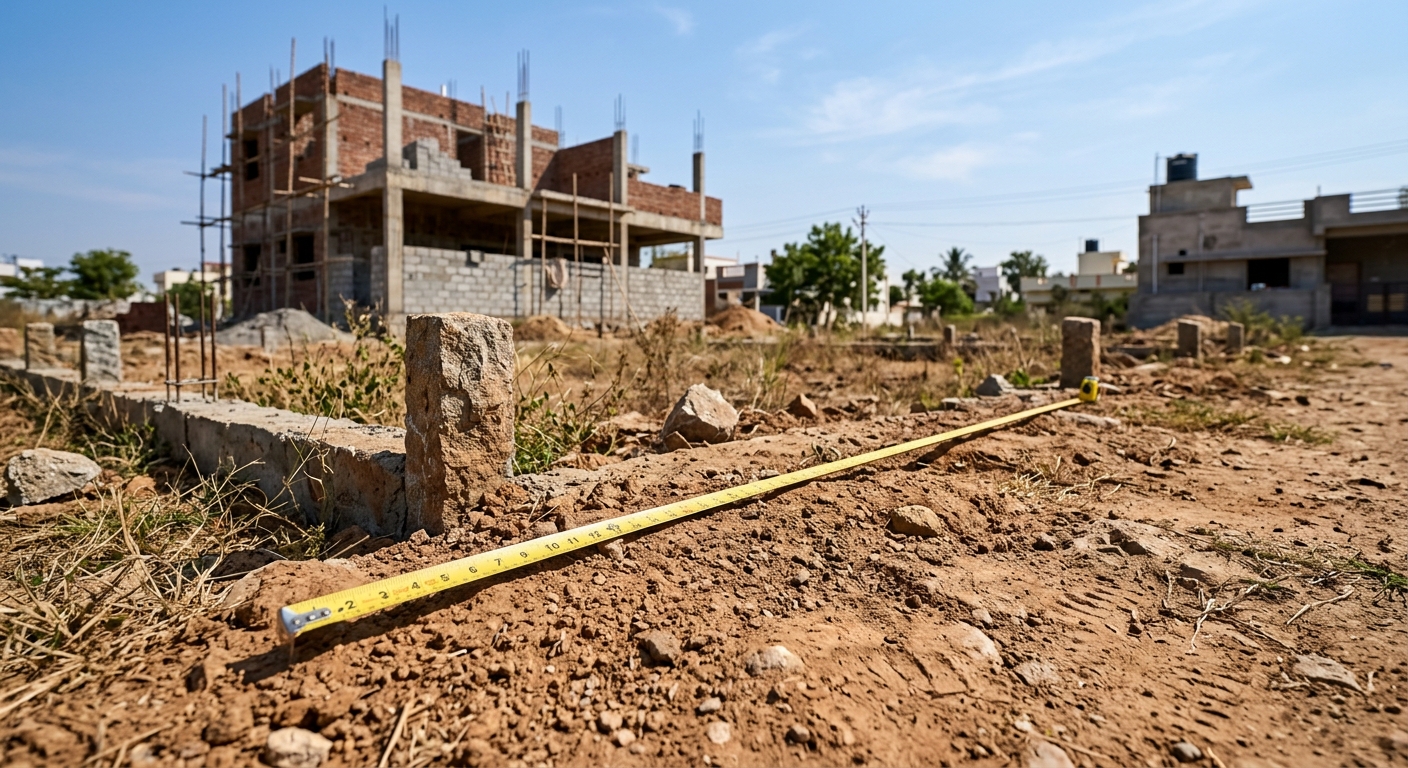
Visit the site. If you’re in India during the search process, visit the property yourself. Walk the plot. Check the boundaries. Talk to neighbors. Look at the roads, water access, electricity connection, and drainage. If you can’t visit, send someone you trust who isn’t the broker. Family works. A local friend works. A hired surveyor works. Just don’t rely entirely on photos and video calls.
We had a case on Freeperty where an NRI bought a plot based on drone footage and Google Maps satellite view. Looked perfect. When he finally visited two years later, half the plot was encroached by a neighboring construction, and the approach road was a dirt path that flooded every monsoon. The documents were clean. The ground reality wasn’t. A single site visit before purchase would’ve caught it.
Check possession status. Is the property vacant and available for handover? Or is there a tenant who refuses to leave? Or an old family member living there under an informal arrangement? Possession disputes are brutal and slow in India. If the property isn’t vacant, get a clear agreement on possession timeline and penalty clauses if the seller can’t deliver.
Verify utilities and infrastructure. Does the property have a clear electricity connection in the seller’s name? Is there municipal water supply or a borewell? Is the sewage connection functional? Are the approach roads paved or under development? These aren’t glamorous questions, but they determine whether your property is livable or sellable in the future. We’ve seen NRIs buy plots in “upcoming” areas that had zero infrastructure even five years later. The plot appreciated in theory. In practice, it couldn’t be sold or built on.
Physical verification is the final reality check. Documents lie sometimes. The ground never does.
Hiring the Right Team: Lawyer, CA, and Local Consultant You Can Trust
You can’t do this alone from 8,000 kilometers away. You need a ground team.
Hire a property lawyer with local jurisdiction experience. Not your cousin who practices corporate law in Delhi. Not a general lawyer who “also does property cases.” You need someone who has handled property transactions in the exact district where you’re buying, who knows the local sub-registrar, who can pull revenue records and title documents without drama. Budget for this. A good property lawyer costs anywhere from ₹25,000 to ₹1,00,000 depending on transaction complexity, and they’re worth every rupee if they catch one title defect that would’ve killed the deal.
Work with a Chartered Accountant who understands NRI taxation. Not all CAs are fluent in FEMA, TDS, and repatriation rules. You need one who has handled NRI property transactions before and can guide you on withholding tax, capital gains treatment, and tax filing timelines in both India and your country of residence. This person will also help you file Form 15CA/15CB when you sell, and they’ll ensure you don’t trigger unnecessary tax liability through poor structuring.
Use a local property consultant or channel partner. Freeperty works with verified channel partners and consultants across India who can act as your ground eyes. They’ll do site visits, verify builder claims, coordinate with lawyers and registration offices, and keep the process moving when you’re in a different time zone. They’re not free, but they’re far cheaper than buying the wrong property.
Build this team early. Vet them. Check references. Make sure they’ve worked with NRI clients before. The cost of a good team is a fraction of the cost of a bad property deal.
Common Mistakes NRIs Make (And How to Avoid Them)
Trusting family without verification. We get it. Your brother-in-law says the property is great. Your uncle vouches for the builder. But family trust doesn’t replace due diligence. Even well-meaning relatives can miss legal details or fail to ask hard questions. Verify independently. Always.
Buying based on future infrastructure promises. Metro line coming soon. Airport expansion planned. IT corridor launching next year. These are great if they actually happen — and terrible if they don’t. Don’t pay today’s premium for tomorrow’s maybe. If the infrastructure isn’t already under construction with a clear timeline, discount it from your valuation.
Skipping the lawyer to save money. A ₹50,000 lawyer fee feels expensive until you’re stuck in a ₹1 crore property dispute. The lawyer isn’t optional. They’re the firewall between you and a catastrophic mistake.
Assuming “RERA-registered” means risk-free. RERA registration is a minimum compliance standard, not a quality certification. It means the project is legal. It doesn’t mean the builder is competent or the project will deliver on time. Do your own builder background check.
Forgetting about annual property taxes and maintenance. Indian property isn’t a set-it-and-forget-it asset. You’ll pay annual property tax to the municipal corporation. If it’s an apartment, you’ll pay monthly or quarterly society maintenance charges. If you’re renting it out, you’ll need a property manager. Budget for ongoing costs — they add up fast.
How Freeperty Helps NRIs Navigate Property Investment in India
Most property platforms in India charge listing fees, lead fees, or subscription fees that filter out individual sellers and small brokers. That’s a problem if you’re trying to see the full market.
Freeperty is completely free — for property owners, brokers, channel partners, and buyers. That openness matters when you’re trying to compare options across cities, localities, and price points. Every listing becomes a searchable landing page, which means you’re more likely to discover properties that aren’t being actively marketed through paid ads.
We also provide area guides, price trend analysis, and investment-focused content that helps you understand not just the property, but the location intelligence behind it. When you’re evaluating a plot in Lonavala or an apartment in Whitefield, you need context — growth stories, infrastructure updates, historical appreciation patterns. That’s where Freeperty’s discovery-focused approach helps.
And because we work with verified channel partners and consultants, you’re not navigating this alone. You get access to professionals who can do ground verification, coordinate legal and tax work, and handle registration when you’re not physically in India.
We’re not selling property. We’re making property discovery transparent and accessible — especially for NRIs who need more information and better filters before making a decision this big.
Frequently Asked Questions
Can NRIs buy agricultural land in India?
No. NRIs cannot purchase agricultural land, plantation property, or farmhouses in India under FEMA regulations. However, if you’re a Person of Indian Origin or hold an OCI card, you may inherit agricultural land from family — but you cannot purchase it outright in the open market. Residential and commercial properties are open for purchase.
Do I need to visit India in person to buy property as an NRI?
Not necessarily. You can execute a registered Power of Attorney in favor of a trusted representative in India who can complete the purchase, sign documents, and register the sale deed on your behalf. The PoA must be notarized, apostilled, and registered in India before it’s valid for property transactions.
How much tax will I pay when I sell property in India as an NRI?
Capital gains tax depends on how long you’ve held the property. If you sell within two years, short-term capital gains tax applies at your income tax slab rate. If you sell after two years, long-term capital gains tax is 20% with indexation benefit. Additionally, the buyer must deduct TDS at the time of sale — currently 20% for long-term gains — which you can claim back when filing your tax return if your actual liability is lower.
Can I repatriate the sale proceeds when I sell my property in India?
Yes, but with conditions. You can repatriate up to USD 1 million per financial year from the sale of residential property, provided you’ve held the property for at least one year and the original purchase was funded through NRE/FCNR accounts or proper foreign inward remittance. You’ll need RBI approval through an authorized dealer bank, along with proof of purchase funding, tax clearance, and sale deed documentation.
Start Your NRI Property Investment with a Real Checklist, Not Just a Budget
You don’t need more property listings. You need better filters. You don’t need faster approvals. You need cleaner documentation. And you don’t need a bigger budget. You need a tighter due diligence process.
NRI property investment India works when the checklist comes before the excitement. When verification happens before payment. When the legal team is hired before the sale deed is drafted. When you treat distance not as a disadvantage, but as a reason to be twice as careful.
Freeperty is built for this kind of informed discovery. Browse properties across India with zero listing fees, compare options with full transparency, and connect with local consultants who can turn your checklist into ground-level verification. Whether you’re investing in Pune, Gurgaon, Kochi, or anywhere in between, you deserve to see the full market — not just the properties that paid to be seen.
Visit Freeperty, explore area-specific listings, read location intelligence guides, and start your investment journey with the due diligence checklist that actually protects you. Because property investment shouldn’t feel like a gamble. It should feel like a decision backed by information, verification, and the right team on the ground.
Complete due diligence checklist for NRI property investment India. Legal, tax, FEMA compliance, title verification & documentation guide from Freeperty experts.