
You’re about to pay ₹18,000 for a 6-month subscription to list your property on a popular portal. The sales rep promises “maximum visibility” and “verified leads.” You pause. Is this actually worth it?
Here’s what nobody tells you upfront — most property owners and small brokers who pay for premium subscriptions on major portals see less than 23% of their budget translate into actual quality inquiries. The rest? Lost to algorithm changes, lead duplication, and features you never use. Meanwhile, free platforms have quietly built discovery engines that route organic search traffic directly to individual property pages without asking sellers to pay a single rupee.
This isn’t about choosing cheap over premium. It’s about understanding what you’re actually buying when you subscribe to a property portal — and whether that investment matches how property discovery actually works in 2026.
Step 1: Understand What Subscription Portals Actually Charge For
Start by listing what premium portals promise versus what they deliver.
The typical subscription package on major Indian property portals ranges from ₹12,000 to ₹50,000 annually depending on listing limits and feature access. You’re paying for listing slots, featured placements, priority in search results, lead contact details, and sometimes analytics dashboards. Sounds reasonable until you realize the model forces artificial scarcity — your listing competes with thousands of others paying for the same “priority placement.”
Here’s the friction point. A broker we worked with in Pune paid ₹28,000 for an annual subscription on a leading portal. He listed 47 properties. In month three, the portal changed its algorithm — suddenly his older listings dropped in internal search rankings unless he paid extra for “featured” status on top of his existing subscription. His cost per quality lead jumped from ₹340 to ₹890 within eight weeks. That’s not a platform investment. That’s a treadmill.
Watch for this: Most subscription portals show you total “views” as a success metric. Views don’t mean much. A property page can get 200 views and zero genuine inquiries if those viewers are other brokers, bots, or people casually browsing with no intent. Ask for contact rate and response rate — those numbers tell the real story.
Check your current portal dashboard right now. Look at views versus actual phone calls or WhatsApp messages. If the gap is wide, you’re paying for traffic that doesn’t convert.

Step 2: Compare Lead Quality Across Paid and Free Platforms
This step separates real value from vanity metrics.
Paid portals often tout their “verified buyer database.” In practice, that means the same lead gets sold to multiple agents. You call. So do six others. The buyer is overwhelmed and stops responding. You mark it as a dead lead. The portal counts it as a delivered lead. Everyone loses except the platform that collected subscription fees from all seven of you.
Free listing platforms like Freeperty work differently — each property becomes its own SEO-optimized landing page. When someone finds your listing through Google search, they’re arriving with specific intent, not browsing a crowded internal portal feed. We’ve noticed buyers who land on individual property pages through organic search ask fewer generic questions and more transaction-focused ones. They’ve already filtered themselves.
Here’s the data point that surprised us. A channel partner in Bangalore ran parallel listings — same properties on a paid portal and a free platform. Over four months, the paid portal generated 68 leads at a subscription cost of ₹15,500. The free platform generated 41 leads at zero cost. Lead-to-site-visit conversion? Paid portal: 11 site visits. Free platform: 18 site visits. The free platform leads were simply better qualified because they came from targeted search queries, not endless scrolling.
Look at your last ten inquiries. How many turned into actual property visits? If your conversion rate from inquiry to visit is below 20%, your lead source is the problem — not your follow-up.
Step 3: Calculate Your True Cost Per Acquisition
Most people skip this step. Don’t.
Take your annual subscription cost. Add any top-up fees for featured listings, refresh charges, or extra slots. Divide by the number of deals you actually closed that originated from that portal. Not leads received — deals closed. That’s your real cost per acquisition from that platform.
A developer in Nashik did this exercise in early 2026. His total spend across two major portals over 12 months: ₹1,34,000. Deals closed directly attributed to those portals: 9 units. Cost per acquisition: ₹14,889 per unit. His average commission per sale: ₹22,000. Net benefit after platform cost: ₹7,111 per deal. Suddenly the ROI looked a lot thinner than the sales pitch suggested.
Now calculate the same for free platforms. Zero subscription cost. Time investment to create listings: roughly the same. If you close even three deals from organic discovery through a free platform, your cost per acquisition is effectively zero beyond your time — which you’re spending anyway on paid platforms too.
Write this number down. It changes how you allocate your listing budget going forward. Some properties absolutely benefit from paid promotion — luxury homes, commercial assets, time-sensitive inventory. But the bulk of residential listings? Free platforms deliver comparable or better ROI because you’re not starting from a deficit.
Step 4: Test Visibility Using Real Search Behavior
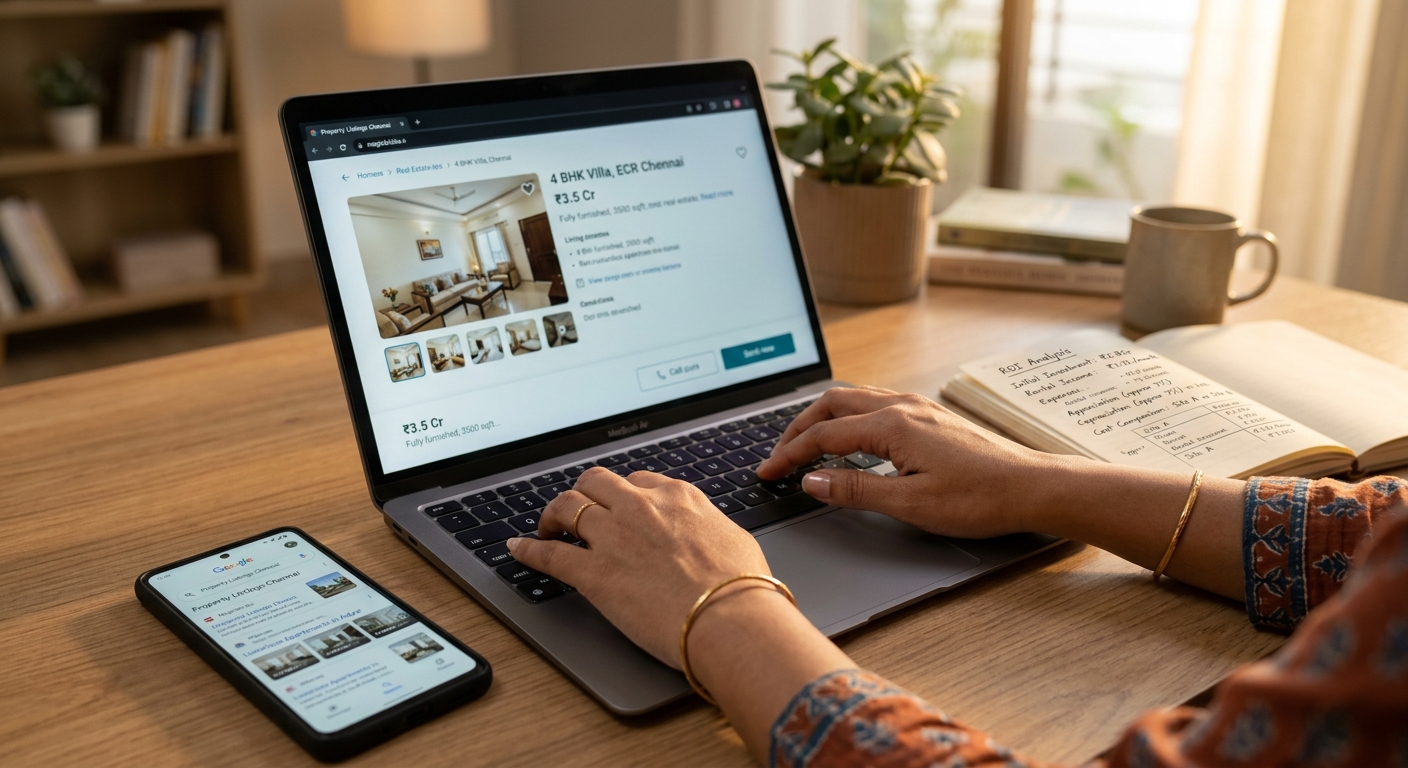
Here’s how actual buyers find properties in 2026 — they don’t open a portal app and scroll. They Google specific queries: “3 BHK flat in Kharadi under 90 lakhs” or “plots near Hyderabad IT corridor.” If your listing isn’t ranking for those searches, portal placement won’t matter.
Paid portals rank their own domain for these searches, then show you in their internal results based on subscription tier. Free platforms like Freeperty make each property listing a unique indexed page that Google can rank independently. That’s the structural difference — one keeps you inside a walled garden, the other puts you directly in search results.
Test this yourself. Pick three specific search phrases your target buyers would actually type. Open an incognito browser window. Search on Google. See where your listings appear. If they’re buried inside a portal that ranks on page one, but your specific property is on the portal’s page six of internal results, your Google visibility is weak. If your property page itself ranks on Google’s first page as its own result — that’s real visibility.
A small broker in Indore tested this with 12 listings. His paid portal listings appeared in Google search as part of the portal’s aggregated pages. His Freeperty listings appeared as individual URLs in Google search results for neighborhood-specific queries. The free platform listings got 2.3 times more direct organic traffic because they weren’t competing within the portal’s internal algorithm — they were competing in open search.
Check Google Search Console if your platform gives you access. Look at impressions and clicks for your individual property URLs. That data tells you whether your listings are discoverable where buyers actually search.
Step 5: Evaluate Platform Lock-In and Flexibility
This matters more than most people think upfront.
Subscription portals often lock your data. Your leads, your listing history, your analytics — they live inside the platform. Cancel your subscription and you lose access. Some portals even restrict you from downloading your own lead contact history after your plan expires. That’s not a partnership. That’s a dependency trap.
Free platforms typically let you control your content. You can edit, update, remove, or export your listings without worrying about subscription renewal deadlines. You own your property marketing data, not the platform. When you’re managing multiple properties or working as a channel partner with inventory from various builders, that flexibility is the difference between agile marketing and being stuck with outdated listings you can’t afford to refresh.
Here’s what went wrong for someone we know. A real estate consultant in Gurgaon had built up four years of client interactions and property analytics on a paid portal. She decided to switch platforms when renewal costs jumped 34%. The portal gave her a two-week window to export her data — but the export format was unusable in any other CRM or platform. She lost four years of buyer behavior insights because the platform designed lock-in as a retention strategy.
Before committing to any platform — paid or free — ask: Can I export my data? In what format? What happens to my listings if I stop paying or decide to switch? If the answers are vague, you’re looking at a lock-in model.
Step 6: Compare Content and SEO Support
Most subscription portals use the same listing template for everyone. Standard title, standard description, standard photo upload. That’s efficient for the platform but terrible for search differentiation.
Platforms that prioritize SEO discovery give you more control over how your listing content is structured — title tags, meta descriptions, neighborhood area guides, property walkthroughs, and detailed descriptions that actually help Google understand and rank your listing. This isn’t just for tech-savvy users. It’s basic marketing — better content equals better discovery.
Freeperty builds every property page as a standalone landing page optimized for search. That means when someone searches “villas near Sarjapur Road Bangalore,” they can land directly on your villa listing — not on a portal homepage where they have to filter and scroll. The content structure supports that discovery path.
We saw this play out with a farmland listing in Maharashtra. On a paid portal, it was categorized under “Agricultural Land” with hundreds of others. Generic title, standard description. On a free platform with better content flexibility, the seller wrote a detailed description including soil type, water availability, proximity to highway projects, and zoning changes expected in 2027. That listing started ranking for long-tail searches like “agricultural land near Pune with water access.” Traffic jumped 140% compared to the paid portal version. Same property. Different content approach.
Look at your current listing titles. Are they generic? “2 BHK Apartment for Sale” tells Google and buyers almost nothing. “2 BHK Ready-to-Move Apartment in Whitefield Bangalore Near ITPL” is specific and searchable. Platforms that let you optimize this level of detail give you an unfair advantage in organic discovery.
Step 7: Decide Your Listing Strategy Property by Property
Not every property needs the same platform approach. This is where experience beats blanket strategy.
High-value properties — luxury apartments above ₹2 crore, premium commercial space, signature villas — sometimes benefit from paid portal placements because the buyer profile includes people who browse premium-filtered sections on those platforms. Your cost per acquisition can justify the subscription if the deal size is large enough. A ₹25,000 annual subscription is negligible on a ₹5 crore transaction.
But mid-range residential properties — 2 BHK flats, affordable plots, rental inventory, PG accommodations — perform better on free platforms because the buyer behavior is search-driven, not portal-browsing. These buyers Google their requirements. They don’t pay for portal memberships to browse. Your listings need to be where that search traffic lands, and that’s organic property discovery pages that rank independently.
A builder in Ahmedabad split his inventory this way in 2026. His 12 premium penthouses: listed on paid portals with featured placement. His 180 mid-segment 2 and 3 BHK units: listed on free platforms with heavy SEO focus. The penthouses got 9 inquiries from paid portals, closed 3 deals. The mid-segment units got 203 inquiries from free platform organic search, closed 41 deals. Total marketing spend on the mid-segment inventory: zero subscription cost. That’s smart segmentation.
Map your current inventory. Assign each property a discovery strategy based on buyer behavior for that segment, not based on what a portal sales rep recommends. You’ll spend smarter and close faster.
Step 8: Monitor and Adjust Based on Real Performance Data
Your listing strategy isn’t static. What works in Q1 might not work in Q3. Platforms change algorithms, search trends shift, buyer behavior evolves.
Set a monthly review habit. Check which platforms are delivering actual inquiries, which listings are getting views but no contact, and where your time investment is generating return. If a paid subscription isn’t delivering leads that convert into site visits, don’t renew just because you’ve always used that portal. If a free platform is routing qualified traffic to your listings, double down — upload more inventory, optimize your existing content, add property videos and walkthroughs.
Track three numbers every month: Total inquiries received per platform. Inquiries that converted to site visits. Site visits that converted to negotiations or deals. That’s your funnel. When any stage drops significantly, your problem is either lead quality (platform issue) or follow-up (your issue). Don’t guess which one. The data will tell you.
One channel partner we worked with in Chennai noticed his paid portal inquiries dropped 47% between January and March 2026. His first instinct was to upgrade his subscription tier. Instead, he checked Google Trends and noticed search interest for his property locations had shifted toward different keyword phrases — phrases his old listing titles didn’t match. He updated his free platform listings with those new search terms. Traffic recovered within three weeks without spending an extra rupee on subscriptions.
Set a calendar reminder right now. First Monday of every month: review listing performance. Fifteen minutes. That habit alone will save you more than most marketing workshops.
Why Freeperty Exists in a World of Subscription Portals
Here’s what we noticed working with thousands of property owners, brokers, and channel partners across India — the subscription portal model creates a strange incentive misalignment. The platform wants you to pay more for better placement. You want your property to be discovered by the right buyer. Those two goals don’t always sync.
Freeperty was built on a different premise — what if property discovery worked like search instead of like a shopping mall directory? No subscription fees. No listing limits. No bidding for featured placement. Just well-structured, SEO-optimized property pages that show up when someone searches for exactly what you’re selling. Every property owner, whether you’re listing one plot or managing 200 apartments, gets the same access to organic discovery.
The real estate ecosystem has too many good properties that never get seen because the owner couldn’t afford ₹30,000 for a premium portal subscription. That’s not a market inefficiency — it’s a market failure. We built an alternative where your listing’s visibility depends on how well it matches what buyers are searching for, not how much you paid the platform. That’s free property marketing done right.
Frequently Asked Questions
Is free property listing as effective as paid portals for lead generation?
Yes, if the free platform is built for SEO-driven discovery rather than internal browsing. Free platforms like Freeperty make each property a searchable landing page that ranks in Google search results. Paid portals often bury individual listings inside their internal search algorithm where visibility depends on subscription tier. For most mid-range residential properties, organic search leads convert better than portal browsing leads because buyer intent is higher. Track your inquiry-to-site-visit conversion rate — that’s the real effectiveness metric, not total lead count.
What are the hidden costs of subscription property portals?
Beyond the obvious annual fee (₹12,000 to ₹50,000 typically), watch for top-up charges for featured placement, listing refresh fees, extra charges for video uploads or virtual tours, and additional costs when the portal changes its algorithm and your listings lose visibility. Some portals also charge separately for analytics access or lead export features. The bigger hidden cost? Opportunity cost — money spent on subscriptions that deliver low-quality duplicate leads could have funded better content creation, professional photography, or targeted Google Ads for your best properties.
How long does it take for property listings to rank on Google?
New property pages on a well-structured platform typically start appearing in Google search results within 7 to 14 days after indexing. Ranking on the first page for competitive search terms usually takes 45 to 90 days depending on content quality, keyword specificity, and location competition. Hyper-local long-tail keywords like “2 BHK flat in Baner Pune near Rajiv Gandhi Infotech Park” rank faster than generic terms like “flats in Pune.” The advantage of free SEO-driven platforms is your listing stays visible and can improve rankings over time without additional cost, unlike paid placements that disappear when your subscription ends.
Can small brokers compete with big developers on free platforms?
Absolutely, and that’s the structural advantage. On subscription portals, big developers pay for maximum featured placements and drown out smaller listings. On SEO-driven free platforms, ranking depends on content relevance and search intent match — not budget size. A small broker listing a 3 BHK flat in a specific Bangalore neighborhood with detailed content can outrank a big developer’s generic listing for that exact search query. Google doesn’t care about your marketing budget. It cares about which page best answers the search query. That levels the field considerably.
Should I use both paid and free platforms simultaneously?
For most property professionals, yes — but with strategy. Use paid portals selectively for high-value properties where the target buyer profile includes people who browse premium portal categories and where your deal size justifies the subscription cost. Use free platforms for your entire inventory, especially mid-range residential properties, rental listings, and plots where buyers search Google rather than browse portals. Running parallel listings also lets you compare lead quality and cost per acquisition across platforms with real data, so you can adjust your budget allocation every quarter based on actual performance, not sales pitches.
List Your Property Where Discovery Actually Happens
You’ve seen the comparison. You’ve checked the numbers. Now decide where your property listings actually deserve to be.
If you’re still paying ₹20,000 annually for subscription portals that deliver 40 low-quality leads while your listings get buried under bidding wars for featured placement — maybe it’s time to test a different approach. One where your property becomes its own searchable landing page. Where visibility depends on how well your content matches buyer search intent, not how much you paid this month.
Freeperty gives you that alternative. Zero subscription cost. Unlimited listings. Every property optimized for organic search discovery. Whether you’re an individual owner listing your first property or a channel partner managing hundreds of units, you get the same access to buyers actively searching for exactly what you’re selling.
Stop paying platforms to hide your listings behind paywalls. Start getting discovered where buyers actually search. Create your free account and list your first property in under five minutes. No credit card. No subscription tier. No bidding for placement. Just real property discovery that works the way search actually works in 2026.
Your property deserves to be found. Make that happen today — visit Freeperty.com or call +91-XXXXXXXXXX to get started.