
Meta Title
Real Estate Price Trends India 2026: Market Analysis & Guide
Meta Description
Track real estate price trends across India in 2026. Step-by-step guide to analyzing property rates, spotting growth zones, and timing your investment right.
Full Article
Real Estate Price Trends in India: 2026 Market Analysis
You’re sitting on a decision. Buy now or wait six months? The property you’re eyeing might appreciate 8% by year-end — or it might stall while another neighborhood doubles its momentum. Understanding real estate price trends isn’t about predicting the future. It’s about reading signals most buyers miss.
Here’s what actually moves property rates in India: infrastructure announcements that take 18 months to reflect in prices, micro-market absorption rates that tell you when supply is tightening, and price-per-square-foot gaps between similar localities that signal undervaluation. Not interest rate headlines. Not budget announcements. Those matter, but they’re lagging indicators.
This guide walks you through tracking property market trends the way channel partners and serious investors do — step by step, with specific actions you can take this week. Not theory. Process.
Step 1: Identify Your Target Micro-Markets Before You Track Anything
Most people start backwards. They track prices everywhere, then get paralyzed by data. You need to narrow your focus to 3-4 specific micro-markets first — neighborhoods you’d actually invest in based on your budget and property type preference.
Here’s how you do it. List out areas within your budget range. Check population density trends and planned metro lines or highway expansions near each area. Cross-reference with actual inventory on platforms like Freeperty to see what’s actively listed versus what’s selling.
A broker we work with in Pune did this in January 2025. Instead of tracking 14 localities, he focused on three specific pin codes near the upcoming metro Phase 3 extension. Within two months, he spotted a 4.7% price uptick in one zone while the other two stayed flat. That’s actionable intelligence — the kind that leads to actual decisions, not just spreadsheets.
Watch out for this: Don’t pick areas just because they’re “hot” on news portals. Hot often means overpriced. You want areas showing early momentum — 2-3% quarterly gains, increasing search volume, rising listed inventory from multiple sellers. That combination tells you demand is building, not peaking.

Step 2: Set Up Your Price Tracking System Using Real Listings
Tracking real estate price trends means watching actual listed rates, not just published reports. Reports lag by 60-90 days. Listings tell you what’s happening right now.
Create a simple spreadsheet. Five columns: Date, Locality, Property Type, Price per Sq Ft, Source Link. Every week, log 8-10 active listings from your target micro-markets. Use Freeperty because every property becomes a permanent searchable page — you can bookmark URLs and revisit them to see if rates changed or properties moved off-market.
Here’s what nobody tells you: listed rates and transaction rates differ by 7-12% in most Indian markets. Sellers list high, then negotiate. So your tracking should note asking rates but also watch how long properties stay active. If listings in a locality move from 45-day average visibility to 22 days, prices are probably rising faster than your spreadsheet shows.
One first-time buyer in Bangalore did exactly this for three months in late 2025. She tracked 47 villa listings in Sarjapur Road localities. By October, she noticed something. Properties under ₹1.2 crore were disappearing in 18 days. Properties above ₹1.5 crore sat for two months. That gap told her where the real demand pressure existed — and where she could actually negotiate.
Track weekly. Not daily, not monthly. Weekly gives you rhythm without noise.
Step 3: Monitor Infrastructure Announcements and Timeline Them Correctly
Infrastructure drives housing price trends India more than any other single factor. But timing matters. A metro announcement doesn’t move prices the day it’s announced — it moves them 14-18 months before the first train runs, when early buyers and builders start positioning.
Your action this week: identify every major infrastructure project within 8 kilometers of your target areas. Note the expected completion quarter. Then track backward. If a metro line opens in Q3 2027, peak price momentum likely hits between Q1 2026 and Q4 2026. You’re looking at current trends, so you’re in that window right now for many projects.
Check these sources weekly: your state’s metro rail corporation website, National Highways Authority announcements, and airport authority expansion plans. These aren’t paywalled. They’re public. Most buyers just don’t read them until it’s too late.
We’ve seen this play out in Noida Extension. The Aqua Line metro announcements in 2023 were public knowledge. But prices in sectors near future stations didn’t spike until mid-2024 — a full 18 months before operations began. Buyers who tracked the timeline and bought during the announcement-to-construction phase saw 23-27% appreciation by the time the line actually opened.
Watch out for this trap: proposed versus approved versus under-construction. Proposed means nothing. Under-construction with visible work means something. Only track projects with tender allocations and ground activity visible on Google Earth updates.
Step 4: Compare Year-on-Year Price Data Across Property Types
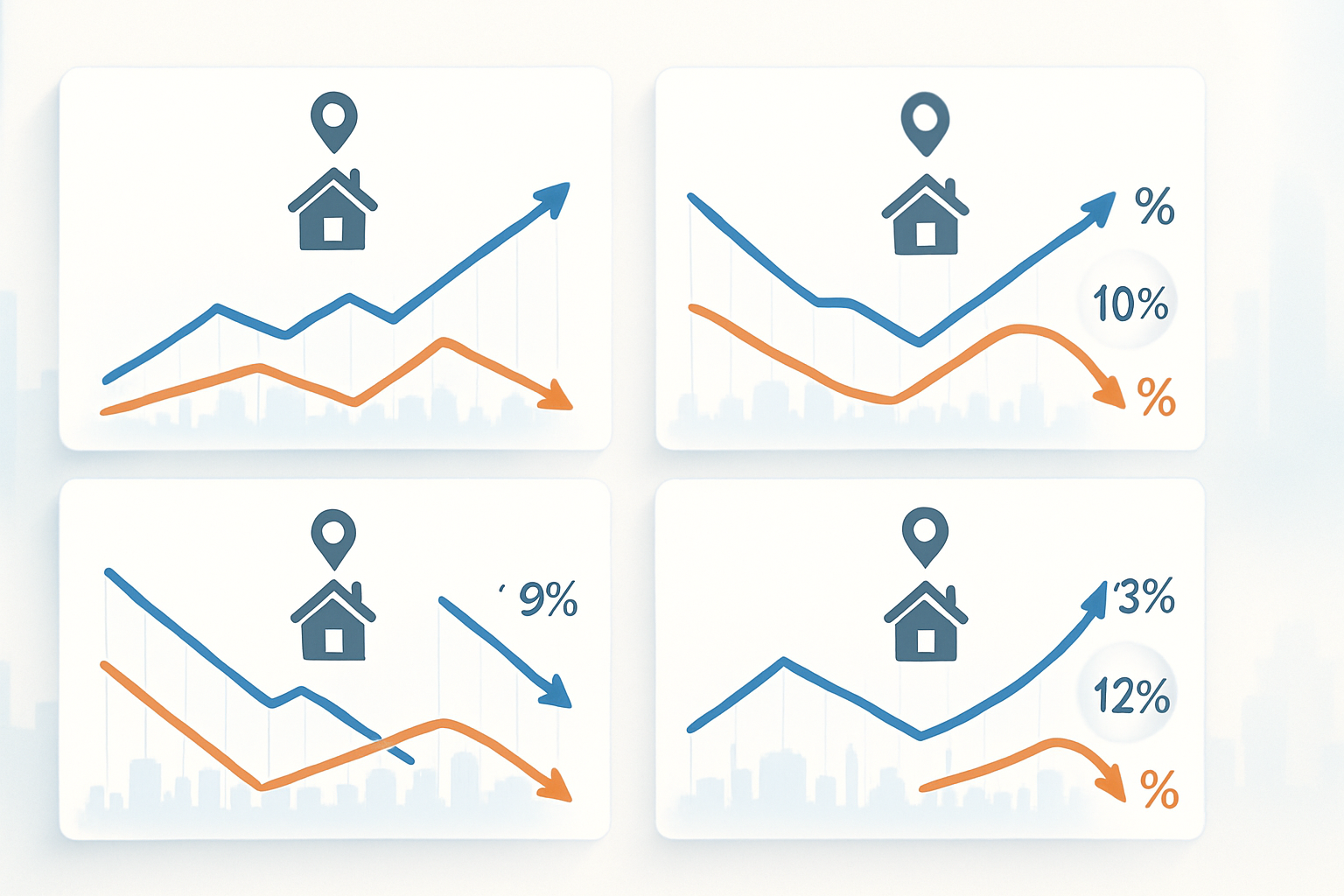
Property market trends aren’t uniform. Villas might gain 11% while apartments gain 4% in the same locality during the same period. Plots might outperform both in appreciation zones, or lag completely in established areas.
Pull year-on-year data for each property type separately. Take the listings you tracked in Step 2. Compare March 2025 average rates to March 2026 rates for 2BHK apartments. Then do the same for 3BHK, plots, villas, and commercial spaces if relevant.
Here’s the insight most investors miss: when apartments slow down but plots accelerate, it signals land value appreciation outpacing construction value. That usually means the area is transitioning from developing to developed. It’s a specific phase where plot investors exit and villa buyers enter. Understanding that transition tells you what to buy and when.
A channel partner we work with tracks property rates India across six cities. In Jaipur, he noticed plots appreciating 9% annually in 2024 but only 3% in 2025 in the same belt near Ajmer Road. Meanwhile, villa transactions jumped 34% in volume. That wasn’t random. The area matured. Builders moved in. Plot speculation phase ended. He adjusted his recommendations accordingly, steering clients toward ready villas instead of land banking.
Your spreadsheet from Step 2 should have separate tabs for each property type. Compare them quarterly. When divergence shows up, there’s always a reason — and often an opportunity.
Step 5: Track Listing Volume and Inventory Churn Rate
Price alone doesn’t tell the full story. You need to know how fast inventory moves. High prices with slow churn means sellers are optimistic but buyers aren’t biting. Rising prices with fast churn means real demand pressure.
Here’s your action: count active listings in your target localities every month. Are there 140 properties listed in February and 180 in March? That’s rising inventory — usually a cooling signal. Are there 140 in February and 98 in April? That’s tightening supply — a leading indicator for price growth.
Then track churn. Revisit the same listings after 30 days. How many are still active? Churn rate below 25% monthly means slow market. Above 40% means momentum. This is granular real estate market analysis you won’t find in published reports.
Freeperty makes this easier because every listing has a persistent page. You can bookmark 50 listings, check back in 45 days, and see exactly which ones moved and which ones didn’t. That pattern tells you more about real demand than any headline price index.
A developer in Lucknow used this exact method in Q4 2025. He tracked 200+ listings across three competing projects. Two projects showed 52% churn in 60 days. His project showed 31%. He didn’t have a price problem. He had a visibility problem. He adjusted his marketing and listing descriptions, pushed organic search optimization harder, and churn jumped to 48% by January without touching rates.
Inventory movement is a leading indicator. Price is lagging. Track both.
Step 6: Cross-Reference with Search Volume and Engagement Data
Prices might not have moved yet, but search interest has. When more buyers start searching for properties in a specific area, prices follow within 90-120 days. This is where most traditional analysis stops — but you shouldn’t.
Use Google Trends. Search for “[locality name] property” or “[locality name] plots for sale” and compare the past 12 months. A steady uptick in search interest signals growing buyer awareness. When search volume jumps 40% quarter-over-quarter, you’re looking at early momentum.
Combine that with engagement on listing platforms. On Freeperty, each property page gets organic search traffic. If you’re a seller or broker, you can see inquiry patterns. If you’re a buyer, you can infer demand by how quickly new listings appear and how detailed the descriptions are getting — sellers put effort into descriptions when competition heats up.
We’ve tracked this across multiple markets. In Gurgaon’s Sohna Road belt, Google Trends showed a 37% search volume increase for “Sohna Road villas” between October 2025 and February 2026. Listed prices didn’t move much — maybe 2-3%. But by April 2026, prices jumped 7% as that search interest converted into actual inquiries and bidding pressure.
You’re reading this in 2026. If search interest is rising now, you’ve got 60-90 days before it fully reflects in pricing. That’s your edge.
Step 7: Validate Trends with On-Ground Broker Intelligence
Data is critical. But boots-on-ground intelligence catches what spreadsheets miss. Talk to local brokers, not just browse listings. Specifically, ask them three questions: What’s selling fastest? What are buyers actually paying after negotiation? What’s not moving at all?
The gap between listed price and transaction price varies wildly. In some Tier 2 cities, it’s 10-12%. In premium Tier 1 neighborhoods, it might be 3-4%. Brokers know this. They live it daily. A 20-minute conversation with a broker active in your target locality will give you price discovery you can’t get from any portal.
One NRI investor we worked with was tracking property market trends remotely for Kochi. His spreadsheet said prices were flat. But when he spoke to three brokers in Kakkanad, all three mentioned the same thing: cash buyers were closing deals 6-8% below listed rates, but loan-dependent buyers were paying full asking price due to rising approval rates from banks. That nuance changed his entire approach. He came in with financing pre-approved and negotiated from strength.
Broker intelligence also reveals shadow inventory — properties not yet listed but coming to market soon. A builder might be ready to release Phase 3 of a project next month. That new supply will affect pricing, but it won’t show up in your listing count until it drops. Brokers know about it now.
Meet with at least two brokers per target locality. Don’t rely on one opinion. Cross-reference what they say with your tracked data. Where they align, you’ve got conviction. Where they diverge, you’ve got questions worth investigating.
Frequently Asked Questions
What are the major factors affecting real estate price trends in India in 2026?
Infrastructure development timelines, micro-market inventory churn rates, and localized demand pressure drive prices more than national policy changes. Metro rail projects, highway expansions, and airport connectivity create appreciation zones 14-18 months before completion. Interest rate movements matter, but they affect transaction volume more than asking prices in the short term.
How often should I track property rates to spot meaningful trends?
Weekly tracking of listed inventory gives you actionable rhythm without noise. Monthly comparisons show price movement patterns. Quarterly year-on-year analysis reveals genuine appreciation or correction trends. Daily tracking creates false urgency and burns time without adding insight. Set a weekly 30-minute review session and stick to it.
Which property types show the strongest price appreciation potential in 2026?
It depends entirely on your target locality’s development phase. Plots outperform in early-stage growth areas where infrastructure is announced but not built. Villas gain momentum in transitioning areas where plots have appreciated and buyers want ready homes. Apartments perform steadiest in established localities with completed infrastructure. Track each type separately within your chosen micro-market instead of following national trends.
How do I know if a locality’s price increase is sustainable or speculative?
Sustainable price growth shows consistent 2-4% quarterly gains over 12-18 months with rising transaction volume and tightening inventory. Speculative spikes show 8-12% jumps in a single quarter followed by stalling or reversal, often with high listing volume and slow churn. Check if infrastructure driving the growth is under construction with visible progress, not just announced. Real appreciation has momentum. Speculation has volatility.
Should I wait for prices to drop before buying property in 2026?
Waiting for price drops in genuinely appreciating areas costs you more than buying at current rates. If your tracked data shows sustained demand pressure, tightening inventory, and infrastructure progress, prices won’t correct — they’ll compound. However, if inventory is rising and churn is slowing, waiting 90 days makes sense. Base timing decisions on your Step 2-6 tracking system, not market sentiment or news headlines. Data removes emotion from the decision.
Ready to Track Real Estate Price Trends That Actually Matter?
You’ve got the framework. Now you need the listings to track. Freeperty gives you free access to properties across India — every listing optimized for search, every property page a permanent URL you can bookmark and revisit to watch price changes over time.
Whether you’re a first-time buyer tracking housing price trends India in your city, an investor watching appreciation zones across multiple markets, or a broker analyzing property rates India for your clients, the platform puts every stakeholder in one searchable ecosystem. No subscriptions. No hidden fees. Just transparent access to the inventory data you need to make informed decisions.
Start tracking your target localities today. Build your spreadsheet. Watch the patterns. And when the data aligns, you’ll know exactly when to move.